Abstract
Purpose – The purpose of this paper is to verify the preferences for the purchase of rosé wine by Italian and French Millennials, with the aim of allowing Italian companies to acquire knowledge in improving the positioning of this product in both the Italian and French markets.
Design/methodology/approach – The study involved a descriptive survey conducted between December 2018 and January 2019 on Millennials residing in Italy and France, intercepted via Facebook. In total, 500 valid responses to a highly structured self-administered questionnaire were collected. Descriptive and multivariate analysis techniques were used to examine the responses.
Findings – The two groups of Millennials show different preferences in the purchase of rosé wine. French Millennials rarely buy the product, and perhaps only for reasonable prices. Their purchasing process involves no characteristics of particular importance. On the other hand, Italian Millennials buy the product with a higher frequency and show a greater propensity to spend. In general, they attribute greater importance (though not a great deal of importance) to the characteristics of the product, paying attention to both its intrinsic aspects and its territorial origin and the quality certifications.
Research limitations/implications – The main limitation of the research is the small sample size. Future insights into the consumption of rosé wine will be sought in other significant European markets.
Practical implications – This study is of value to academic researchers, wine industry practitioners and other members of the wine distribution channel, as it provides insights into consumer behavior differences.
Originality/value – This research is the first to compare rosé wine preferences of Millennials in France and Italy.
Keywords Willingness to pay, Rosé wine, Millennial generation, French wine market, Italian wine market
Paper type Research paper
Introduction
Italy is the world’s largest wine producer, the fourth greatest producer of rosé wine and the third greatest wine consumer. Although rosé wine has seen a 32 percent growth in worldwide consumption over the last 15 years, its consumption has halved in Italy, from 8 to 4 percent of the world total, over 10 years.
Considering this, we have attempted to observe which features of rosé wine deserve particular attention from Italian companies in order to reposition Italian rosé and encourage a recovery in domestic consumption. This in-depth study was carried out using respondents from the Millennial generation; the Pew Research Center defines the Millennial birth range as 1981 to 1996 (ages 23–38 in 2019, www.pewresearch.org).
The consumption of wine among young people is a topic of growing interest in the sector’s literature, which has repeatedly analyzed the relationship between age and consumer attitudes (De Magistris et al., 2011; Wiedmann et al., 2014), paying particular attention to the habits of Millennials. This interest is justified by the peculiar relationship that Millennials have established with the world of wine: they consider the consumption of this product as a true lifestyle, and as granting a moment of conviviality and social connection (Agnoli et al., 2011; Ritchie, 2011; Thach and Olsen, 2006). Wine furthermore represents a deeply engaging experience for Millennials, who tend to become particularly attentive at the moment of purchase (Richard K Miller and Associates, 2011).
Among the studies that have considered the wine consumption behavior of the Millennial generation are those of Higgins et al. (2016), Chrysochou, Krystallis, Mocanu and Lewis (2012), Barber et al. (2008), Nowak et al. (2006), Thach and Olsen (2006) and Wolf et al. (2005). Some studies have also focused on Millennial wine consumption habits in specific countries, such as Australia (Teagle et al., 2010), New Zealand (Treloar et al., 2004), India (Mehta and Bhanja, 2018) and China (Li et al., 2011), and in European countries such as the UK (Mintel, 2009; Ritchie, 2007; Wine Intelligence, 2009), Turkey (Nazan Gunay and Baker, 2011), Portugal (Freitas Santos and Cadima Ribeiro, 2012), Italy (Pomarici and Vecchio, 2014, Bresciani et al., 2016), Spain (Garcia et al., 2013; Velikova et al., 2016) and Macedonia (Hristov and Kuhar, 2015).
More in-depth studies of this topic are needed, especially in the old wine regions of Italy and France, as the Millennial target is becoming increasingly important. In general, wine consumption among Millennials constitutes 19 percent of the total market (McMillan, 2017). Millennials in Italy represent 16 percent of the population and consume 11 percent of the country’s wine (Nomisma wine monitor). Millennials in France make up 18 percent of the population and contribute considerably to wine consumption.
The emotional and sensorial peculiarities that characterize Millennials’ consumption behavior make them a consumer target that can change the traditional approach to the consumption of this product. This particularly applies to types of wine like rosé, which on the international market has been increasingly seen to be able to adapt to changes in lifestyles and ways of consuming wine by new generations (Velikova et al., 2015). Italy is the fourth largest producer of rosé wine, with a 2017 output of 2m hectoliters (mlh; www.franceagrimer.fr), or just under 10 percent of world production. Nevertheless, the 2017 consumption of rosé wine in Italy was only slightly over 1 mhl, or about 5 percent of global consumption. This is clearly a product in decline in Italy; in the previous decade, 8 percent of global rosé wine consumption occurred in Italy (30 percent less in total). France is the greatest consumer of rosé wine, at around 8.5 mlh in 2017; this represents about 33 percent of the global consumption of 23.4 mlh, but is about 3 percent less than the 2016 value. France is also the leading producer of rosé wines, with about 5.6m hectoliters produced in 2017.
The objective of this paper is thus to verify the rosé purchasing preferences of Italian and French Millennials.
These countries have in common a long tradition of wine consumption and production and its consumers in general show high involvement with wine. To the best of our knowledge, this segment has not yet been sufficiently observed, and there is not yet an analysis of exhaustive consumption preferences in terms of purchasing preferences. Then, in this paper, we attempt to fill this gap in the literature and we aimed to generate useful knowledge for Italian companies in defining product positioning strategies for both the Italian and French markets. Specifically, the cross-country analysis seeks to answer the following research questions:
RQ1. Do the preferences (in terms of the importance ascribed to attributes) of Millennials for rosé wine consumption vary between the Italian and French markets?
RQ2. Does consumer spending on rosé wine change in relation to the importance assigned to product attributes? Do the Italian and French markets show similar trends?
RQ3. Are digital information sources important in choosing rosé wine? If so, are there elements of similarity between Italian and French consumers?
The structure of the paper is as follows: the next section provides the theoretical background to the research. The third section illustrates the method employed in the empirical analysis, the fourth section reports on the main findings of the empirical study, and the last two sections, respectively, discuss the main findings and outline avenues for future research.
Theoretical background
Cognitive aspects of the product and Millennial-specific behavior relating to wine
The unique and highly complex nature of wine, which is configured as a product with high experiential and emotional intensity, means that any evaluation of its quality assumes a multidimensional characteristic, being the result of the different relevance assumed by the multiple attributes of the product with respect to the preferences of the consumer (Charters and Pettigrew, 2003; Tempesta et al., 2010; Corduas et al., 2013; Fait et al., 2014; Wiedmann et al., 2014; Bruwer et al., 2017; Schäufele et al., 2018).
The characteristics on which a consumer’s evaluation of wine is based are intrinsic and extrinsic (Olson and Jacoby 1972; Veale and Quester, 2009). The intrinsic characteristics are those related to the chemical and physical properties of the product, which cannot be modified after bottling. There are five such aspects (Charters and Pettigrew, 2007): its hedonistic characteristic (personal pleasure and fun); the visual aspect; the taste and aroma properties (associated with the grape and vine varieties); the paradigmatic nature (the quality of the wine, once tasted, is also judged based on its ability to evoke something foreign to the drink itself ); and aging.
It is evident that appreciation of the intrinsic characteristics of the product is inseparably linked to the experience of consumption. It is not by chance that the intrinsic properties are what the quality judgments of producers and experts are generally based on Sáenz-Navajas et al. (2014). Since these characteristics cannot be evaluated until the product has been consumed, they mainly affect repurchase (Spielmann et al., 2016). The initial purchase decision, however, may be based on extrinsic characteristics (Lockshin and Hall, 2003; Lockshin and Halstead, 2005; Lockshin et al., 2006; Remaud and Lockshin, 2009), or on those aspects inherent to the product that are not physically part of it (Olson, 1977), although they can in certain circumstances determine its connotations.
For example, territorial origin (Veale and Quester, 2008, 2009; Tempesta et al., 2010) plays an important role in the construction of the concept of quality, especially when the specificity is such as to generate a region-of-origin effect which, evoking the traditions, beliefs and culture of the territory from which it emanates, gives rise to a cognitive process that positively affects the consumer’s evaluation (Van Ittersum et al., 2003; Chamorro et al., 2015; Vrontis et al., 2016; Scorrano et al., 2018). Another fundamental typology of extrinsic characteristics consists of marketing elements, including packaging, reputation and price (Charters and Pettigrew, 2007). The packaging has its own subdimensions, such as label aesthetics (Rocchi and Stefani, 2006; Chrea et al., 2011) and the information it displays (Mueller et al., 2010), color and shape of the bottle (Raz et al., 2008; Mueller and Szolnoki, 2010; Chrysochou, Corsi, Krystallis, 2012). The term “reputation,” on the other hand, refers to quality certifications, awards (Lockshin et al., 2006, Giacomarra et al., 2016) and brand (Mueller et al., 2010).
The questionnaire uses 16 wine attributes largely described in the literature. A new element of the paper is the identification of wine attributes inherent to innovation (innovative packaging, advertising sites and social networks, positive opinion expressed by experts through digital channels), and the link between the product and the territorial origin (graphically attractive label, quality certification).
These intrinsic and extrinsic characteristics are perceived differently by different generations of consumers. Various studies have shown that considerable differences in wine consumption can be identified across generations, which supports market segmentation on the basis of age cohorts (Barrena and Sanchez, 2009; Agnoli et al., 2011; Chrysochou, Krystallis, Mocanu and Lewis, 2012). In general, data show a growth in wine consumption to middle age, and then a decrease thereafter. In fact, at the beginning of the twenty-first century, marketing efforts were aimed at the baby boomer generation, but in recent years the focus has shifted to young people (Bruwer et al., 2012).
Millennials, their attitudes and their buying patterns have become an important reference point for marketers and researchers in terms of potential spending power, ability to be trend setters and attitude toward new products (Thach and Olsen, 2006; Radovanović et al., 2017). Despite their younger age, Millennials represent an important consumption segment due to their purchasing power, their significant influence on the purchase decisions of their families and their ability to involve peers. Millennials tend to buy limited amounts of wine as part of a portfolio of alcoholic beverages (Mueller and Charters, 2011; Chrysochou, Corsi, Krystallis, 2012; Chrysochou, Krystallis, Mocanu and Lewis, 2012). They prefer consumption outside the home, buying the product in limited quantities and in alternative packages.
They do not aim to consume large quantities, but rather to have a multisensory experience; they appreciate personal appearance and well-being (Castellini and Samoggia, 2018).
The characteristics of wine consumption among Millennials seem to vary by country. The propensity to purchase red or white wine varies between countries (Olsen et al., 2007; Teagle et al., 2010, VinIntell, 2013). Mueller and Charters (2011) have already called for attention to be paid to the fact that research carried out on consumers is not transferable to other countries, given the cultural and market peculiarities of each.
These countries have in common a long tradition of wine consumption and production. In addition, French and Italian consumers in general show high involvement with wine. In both countries, the preferences of wine consumers are mainly driven by proximity to wine-producing areas and the wine producers; geographical indications (i.e. Protected Designations of Origin and Protected Geographical Indications) play a relevant role in wine consumer choices (Casini et al., 2009).
So, our first research question is:
RQ1. Do the preferences (in terms of the importance ascribed to attributes) of Millennials for rosé wine consumption vary between the Italian and French markets?
Willingness to pay and characteristics of product
Considering that wine-buying processes are stimulated by the perception and evaluation of the product’s characteristics, some studies (Batt and Dean, 2000; Oczkowski, 2001; Lockshin et al., 2006; Barreiro-Hurlé et al., 2008; Sellers-Rubio and Nicolau-Gonzalbez, 2016) have shown how these are reflected in the price factor, taken to be the most relevant dimension, in particular for those consumers who drink wine infrequently, as well as for those who tend to buy the most expensive wines. For this reason, we analyzed willingness to pay (WTP) – that is, the willingness of Millennials to spend money on the purchase of rosé wine. This will allow us to learn more about the drivers of consumer choice (Wertenbroch and Skiera, 2002; Voelckner, 2006; Didier and Lucie, 2008; Franke and Schreier, 2008; Schäufele and Hamm, 2017).
The degree of consumer involvement with the product is, in fact, an important construct in examining WTP (Barber et al., 2009): in fact, it depends to a large extent on the level of information available at the time of purchase, and therefore on the consumer’s knowledge of the product’s characteristics (Lecocq et al., 2005; Hammond et al., 2013; Galati et al., 2019). On the other hand, the price the buyer is willing to pay is a function of the utility attributed to the product and the benefits he or she believes can be derived from its consumption: in other
words, it is an expression of the value attributed to the product – value that is associated with tangible and intangible factors (Lewis and Zalan, 2014). With specific reference to wine, the WTP of less experienced consumers is influenced in particular by extrinsic factors, such as information on taste reported on the label or in guides. Such consumers tend to rely on these indications to judge the quality of the product, rather than distinguishing specific sensorial qualities and expressing their preferences in terms of them, and consequently associating with them a certain WTP (Holmquist et al., 2012; Lecocq et al., 2005). WTP is also strongly affected by the perception of the brand (Aaker, 1996; Schiffman et al., 2008): a positive brand image can generate brand loyalty and increase the value of the product in the consumer’s view, who might then be willing to pay a premium for it.
So, our second research question is:
RQ2. Does consumer spending on rosé wine change in relation to the importance assigned to product attributes? Do the Italian and French markets show similar trends?
Digital information and choice of rosé wine
The need to acquire useful information in purchasing decisions and in quantifying the willingness to spend is now favored by the presence of digital communication channels. Reputation is strongly influenced by social media channels, which act to aggregate opinions and orientations, and from which important aspects of the brand image can emerge (Cavallo et al., 2016; Iaia et al., 2017; Sogari et al., 2017; Galati et al., 2016, 2017).
In general, perception of the characteristics of the product is facilitated by the diffusion of social media, which have profoundly altered the ways in which consumers interact with each other and with businesses; this is due to the active role that web-based communication models have entrusted to users in the generation and dissemination of content, forcing companies to review their marketing strategies. Platforms and digital tools allow users to share content, recommend products and describe their experiences (positive or negative) of consumption, developing powerful word of mouth (Brown and Hayes, 2008; Iaia et al., 2016). Word of mouth plays a fundamental role in influencing purchasing decisions on social media (Ahamed and Zahid, 2014), particularly for products with a high cognitive or experiential content, such as wine. In fact, user-generated content is a rapidly growing communication phenomenon among wine consumers, especially in the form of wine blogs (Forbes et al., 2015): according to a list drawn up by Vinography in 2018, there are over 765 blogs dedicated to wine in English, along with another 175 written in other languages (www.vinography.com/wine_blog_list.html). These represent an important source of information for consumers (Cosenza et al., 2015; Scorrano, Fait, Maizza, 2015).
It has thus become essential for companies to know the channels through which to communicate and share useful information with Millennials at the genesis of purchasing preferences (Fait et al., 2015; Scorrano, Fait, Rosato, Gravili, 2015; Cuomo et al., 2016; Iaia et al., 2019; Scorrano et al., 2019).
So, our third research question is:
RQ3. Are digital information sources important in choosing rosé wine? If so, are there elements of similarity between Italian and French consumers?
Methodology
Sample
The objective of the paper is to verify preferences for rosé wine among Italian and French Millennials. Millennials are a segment that faces the market and that will characterize the near future. In this study, Italian Millennials were contrasted with French Millennials, as France is the largest consumer (and producer) of rosé wine. Millennials represent a homogeneous group of consumers, which minimizes the difference between groups (Geraci, 2004).
After comparing the purchase and consumption habits of rosé wine among French and Italian Millennial people, we attempted to answer the previous research questions through a descriptive survey conducted between December 2018 and January 2019 of individuals aged 23–38 residing in Italy and France. The sample was intercepted via Facebook using features that allow user segmentation. A minimum quota of 200 surveys from each market was set in order to obtain an adequate number of responses for the comparison analysis. Correctly completed questionnaires were received from 500 respondents, of which 290 were completed by Italians and 210 by French.
Questionnaire
The questionnaire employed a web-based survey consisting of three sections. Section A included questions referring to participants’ sociodemographic characteristics and wine consumption behavior, with screening questions to exclude participants who have never bought wine and who were born after 1995. Section B asked participants to rate the importance of the following set of 16 wine attributes described in the literature: variety, vine, organoleptic and sensory characteristics, territorial origin, name of the producer or brand, alcohol content, special offer, label, graphically attractive label, innovative packaging, quality certification, awards, advertising on traditional media, advertising on sites and social networks, suggestions from friends and relatives, and positive opinion expressed by experts. The identification of purchasing attributes was carried out considering the distinction between intrinsic and extrinsic characters (Olson and Jacoby, 1972; Veale and Quester, 2009; Chrysochou, Corsi, Krystallis, 2012; Chrysochou, Krystallis, Mocanu and Lewis, 2012; Lategan et al., 2017). The number of items used is justified by the need to verify the role of additional characters, in comparison with those suggested by literature, regarding to innovation (innovative packaging, advertising sites and social networks, positive opinion expressed by experts through digital channels), and the link with the territorial origin (graphically attractive label, quality certification).
The importance of product characteristics was rated on a five-point Likert scale (1 = least important; 5 = most important). Section C included additional questions related to digital information sources and WTP.
Analysis
The responses were initially analyzed in a descriptive manner, identifying the specificities of rosé wine consumption (purchase frequency, places of consumption, willingness to spend and communication tools used to acquire product information) in the analyzed geographical contexts.
The first step in the processing of the data for the quantitative analysis focused on an “Independent samples t-test,” to identify differences in the importance assigned to product attributes. The “Independent Samples t Test” compares the means of two groups analyzed in order to determine whether there is statistical evidence that the associated population means are significantly different. In particular, the “Levene’s Test of Equality of Variance” is an inferential statistic used to assess the equality of variances for a variable calculated for two or more groups. That test tells us if the two groups that we are comparing have a similar dispersion of scores (otherwise known as homogeneity or equality of variance). If the significance level (also called the probability or p-value) is smaller than 0.05, then there is support for our hypothesis. If it is larger, then we reject our hypothesis in favor of the null hypothesis, which is that there are no differences between the two groups.
The second step in the processing of the data for the quantitative analysis focused on the analysis of multiple linear regression between the WTP (dependent variable) and the intrinsic and extrinsic rosé wine characteristics (independent variables), which can be considered potential “predictors” of the purchase of a product. Initially, it was verified the goodness of fit of the model used by calculating the linear coefficient of determination R² (which represents the portion of the variance of the dependent variable that is explained by the independent variables). Fisher’s test and the analysis of residuals (i.e., the difference between the real and estimated values of the dependent variable) also confirmed the adequacy of the regression model used.
Findings
Sample characteristics
The sample of respondents were predominantly female (56 percent), with males in the minority at 44 percent. The majority of respondents (60 percent) were between the ages of 23 and 27; a third of respondents (33 percent) were aged from 32 to 38, while the remaining 7 percent belonged to the 28–31 age group. Two Italian Millennials out of three had visited rosé production or processing locations, an experience shared by only one in three of their French counterparts. French Millennials consume rosé wine to a greater extent in the family, while Italian Millennials show greater consumption outside the home. In both cases, however, the consumption of rosé is linked to specific events or to certain relational contexts (with friends). Table I shows the answers reported by Millennials regarding individual consumption locations. The comparison shows on average different behaviors, if only slightly, between the two countries. Italian Millennials assign greater value to the location of consumption, though the sample shows a high standard deviation (SD), an index of a varied choice. In order to describe the purchasing characteristics of the two groups, we proceeded with an analysis of willingness to spend money on rosé and of the frequency of consumption; this survey confirmed the diversity of behavior between the groups and the greater variety within the Italian consumer group. Table II shows that there is greater willingness to spend among Italian Millennials, although the high SD indicates divergent behaviors within the group. The frequency of consumption is low for both groups, with the behaviors of the Italian respondents more varied than those of the French respondents (SD: 1.64).
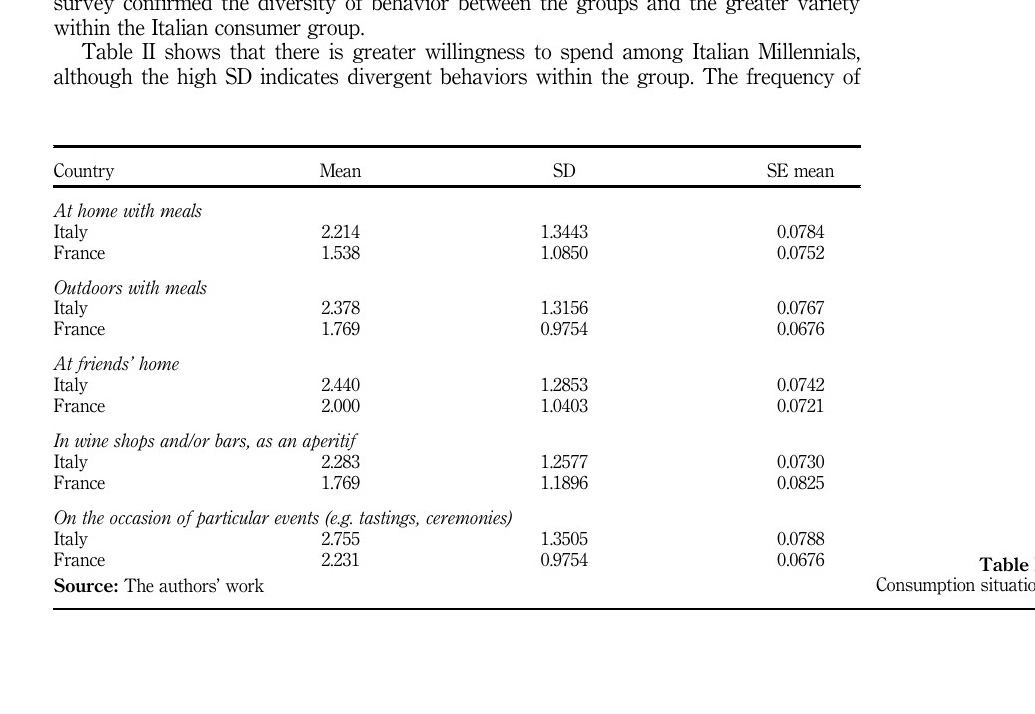
Italian Millennials compared to their French counterparts
RQ1. Do the preferences (in terms of the importance ascribed to attributes) of Millennials for rosé wine consumption vary between the Italian and French markets?
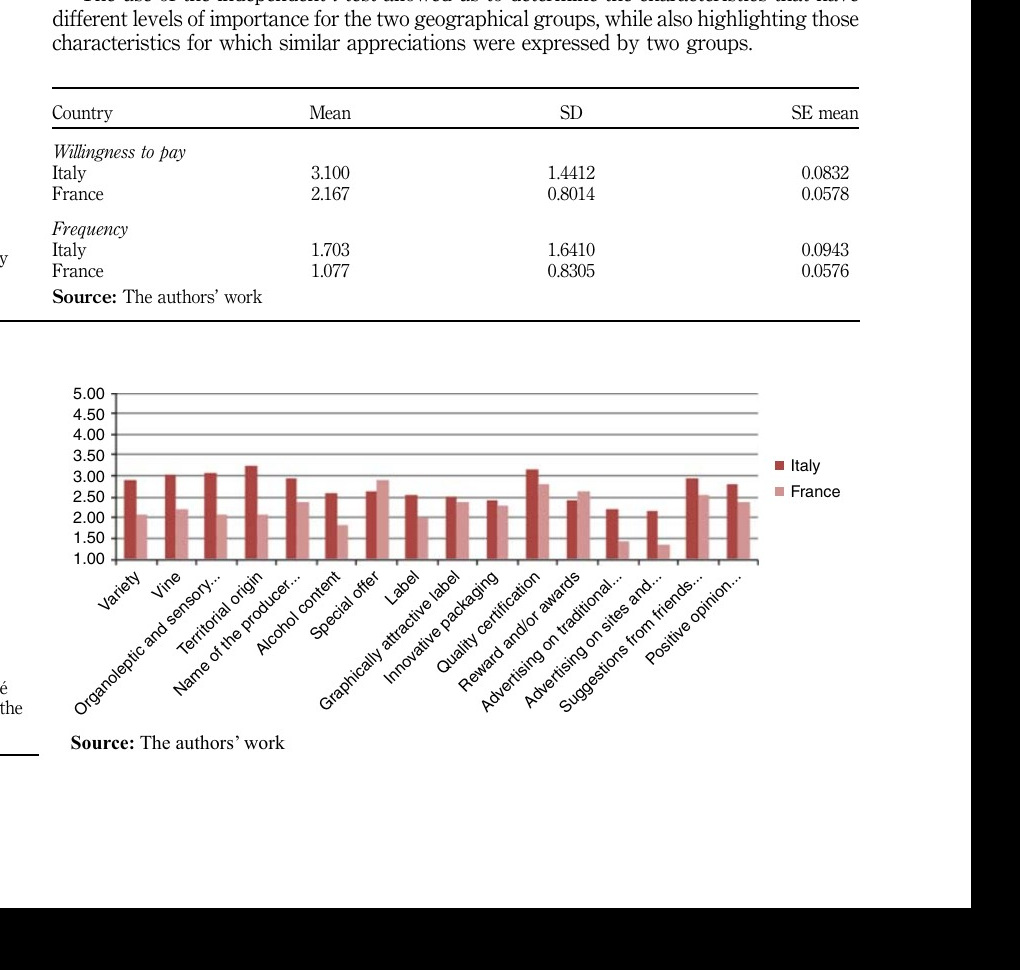
Our review of the literature made it possible to identify 16 distinct items, including both intrinsic and extrinsic characteristics. The respondents described how important each was in process of selecting rosé wine. The results, as shown in Figure 1, show that greater attention was paid to 15 of the attributes by Italian consumers; the exception is the “special offer” item, which was considered more important by the French consumers. Neither consumer group shows any particularly important attributes in the selection processes. The product characteristics considered important (a score of 3 or more) by Italian Millennials are territorial associations (“territorial origin,” 3.26), quality certifications (3.17) and the sensory organoleptic qualities (3.08). For French Millennials, only the presence of a “special offer” (2.91) has an importance close to the average value; a slightly lower level of importance is assigned to “quality certification” (2.82).
The use of the independent t-test allowed us to determine the characteristics that have different levels of importance for the two geographical groups, while also highlighting those characteristics for which similar appreciations were expressed by two groups.
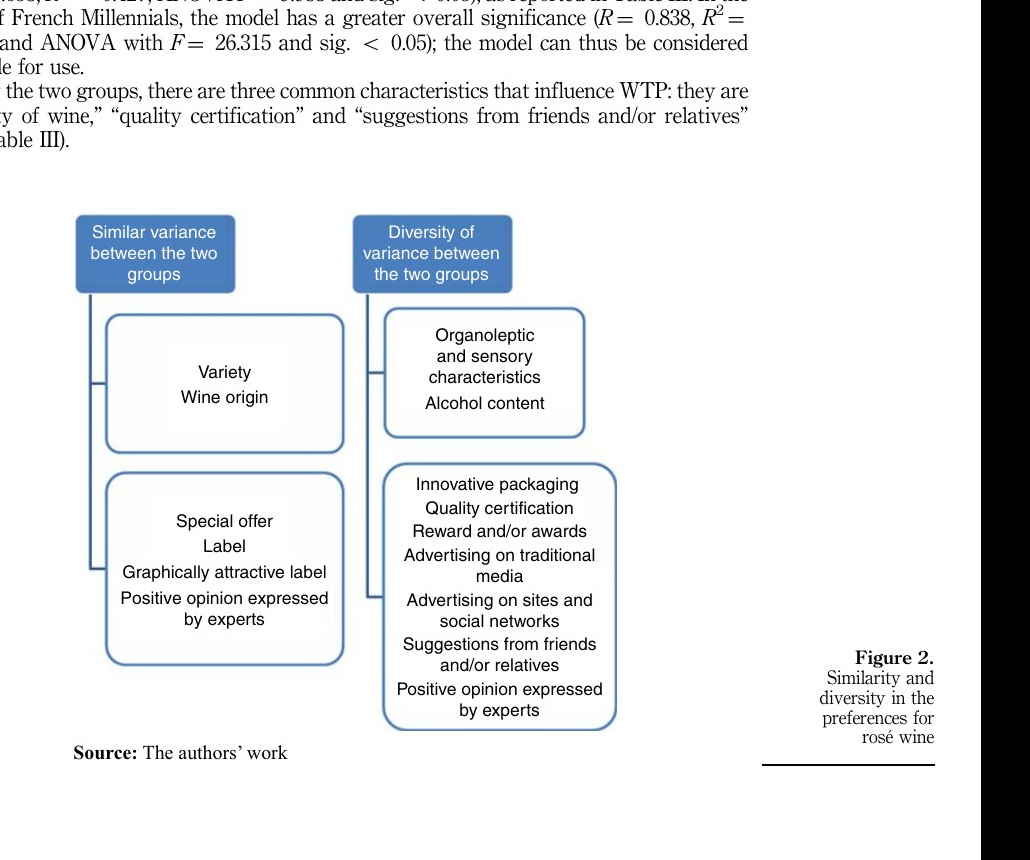
With reference to the differences, the variance of the responses between the samples, analyzed with Levene’s test for the equality of variances, showed a high significance (< 0.05), confirming the diversity of variance between the two groups (see Figure 2). For the other characteristics, the absence of significance rules out the null hypothesis (of different variances), identifying similarities of variance with respect to the importance assigned to the attributes by the two groups.
Although there is a different importance attributed to the characters from the two groups observed, the results of the independent samples highlight the attributes whose evaluation unites the two groups: “variety” and “wine” for the intrinsic characteristics and to “special offer,” “label,” “graphically attractive label” and “positive opinion expressed by experts” for the extrinsic characteristics:
RQ2. Does consumer spending on rosé wine change in relation to the importance assigned to the product attributes? Do the Italian and French markets show similar trends?
It is important in rosé wine positioning strategies for Millennials to determine if there are relationships between the importance assigned to purchasing attributes and the willingness to spend. A regression analysis was carried out separately on the two groups.
The descriptive analysis found that Italian respondents were willing to pay more on rosé than the French respondents. Regression analysis showed an acceptable significance (R = 0.653, R² = 0.427, ANOVA F = 9.983 and sig. < 0.05), as reported in Table III. In the case of French Millennials, the model has a greater overall significance (R = 0.838, R² = 0.702, and ANOVA with F = 26.315 and sig. < 0.05); the model can thus be considered suitable for use.
For the two groups, there are three common characteristics that influence WTP: they are “variety of wine,” “quality certification” and “suggestions from friends and/or relatives” (see Table III).
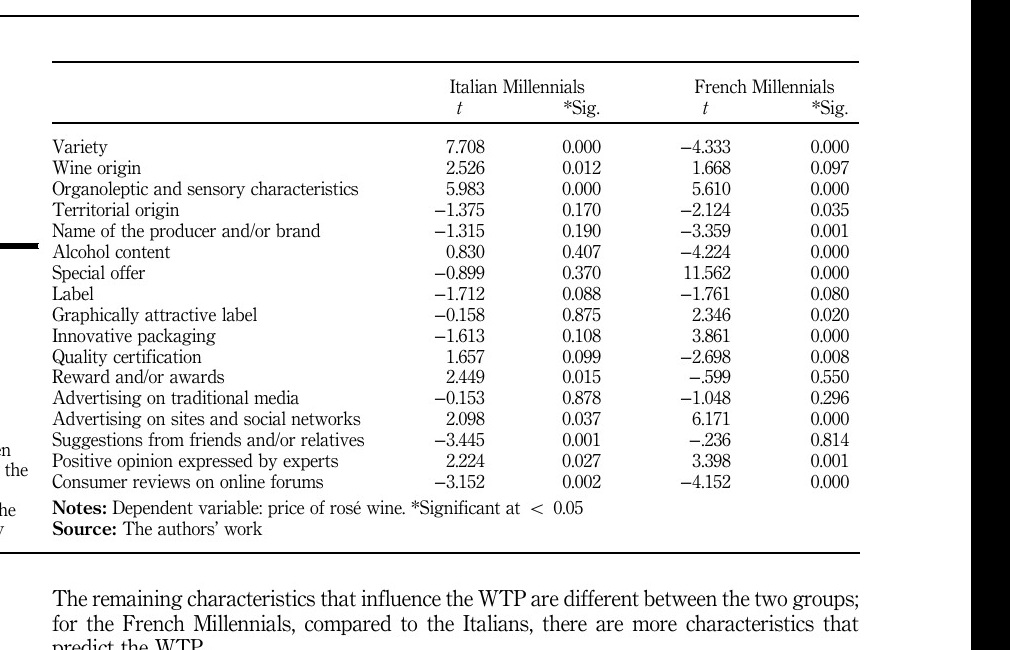
The remaining characteristics that influence the WTP are different between the two groups; for the French Millennials, compared to the Italians, there are more characteristics that predict the WTP.
The French Millennials are less willing to pay for rosè wine and there are various characteristics that can affect it. The Italian Millennials spend more on rosé wine and the expense can change in consideration of the product and its origin or for the suggestions of friends:
RQ3. Are digital information sources important in choosing rosé wine? If yes, are there elements of similarity between Italian and French consumers?
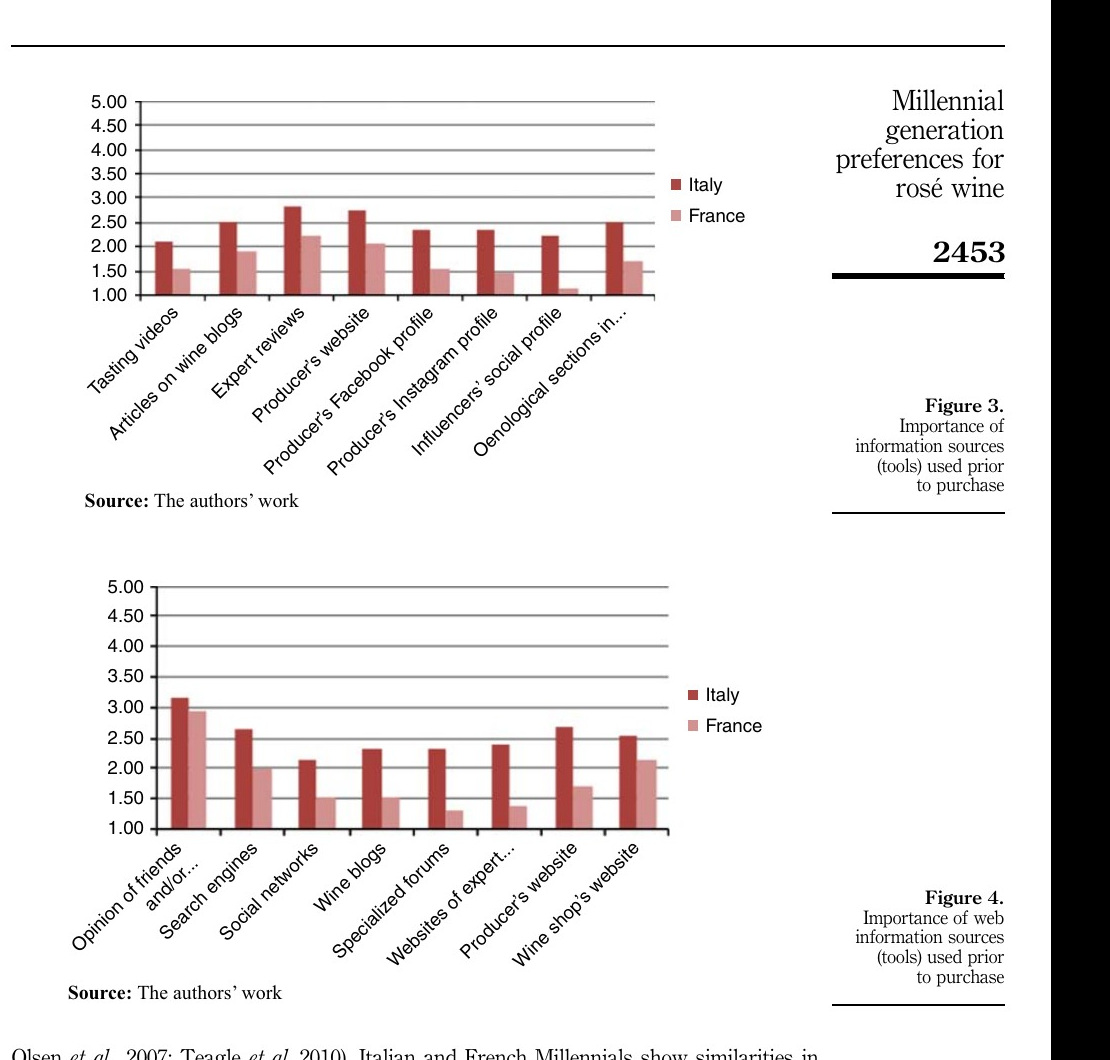
A further objective of the paper is to determine the use by Millennials of communication tools to obtain information used in evaluating such characteristics. This particularly refers to the possibilities of digital technology. Italian Millennials consider “expert reviews” and “producer’s website” to be important when seeking information on rosé wine. The remaining tools are not important for acquiring information or knowledge about the product. For French Millennials, none of the communication tools are very important in obtaining information useful for purchasing rosé (see Figure 3).
The web information sources do not improve the importance of communication for Millennials. “Friends and experts” are of above average importance for both groups. In general, Italian Millennials are more attentive to the producer’s website and to results found through search engines. The two groups of Millennials thus behave altogether differently (see Figure 4).
Communication thus appears, on the whole, not to play a great role in Millennials’ acquisition of knowledge useful in purchasing rosé. Although the respondents are consumers of the digital age, traditional word of mouth still has a greater weight in the search for information on the characteristics of rosé wine.
Discussion
First of all, our analysis highlighted the difficulty of analyzing the rosé wine market without considering the peculiarities of different national markets (Mueller and Charters, 2011; Olsen et al., 2007; Teagle et al. 2010). Italian and French Millennials show similarities in terms of the occasions on which they use rosé wine, being mostly associated with events and special occasions, followed by dinners at friends’ houses and outside the home. On the other hand, consumption of rosé wine at home appears to be limited, demonstrating an evident association between rosé wine and social phenomena.
The analysis of preferences showed differences between the two contexts (RQ1). The most significant attribute for the Italian market is the wine’s territory of origin, followed by quality certification, if present. This aspect demonstrates the growing importance of territory, in the form of symbolic values and evocative references, in the choice of wine (Van Ittersum et al., 2003; Scorrano et al., 2018). This aspect is reinforced by the relevance of quality certifications (D'Amico et al., 2016) as an element that can, for the most part, enhance the link with the territory. Additional attributes that can positively orient the consumer choice process can be traced back to the brand (Ahamed and Zahid, 2014). Moreover, the analysis shows that there is no single attribute which, on account of its relevance, can act as a central element in orienting the selection process. Italian and French Millennials orientate their own selection processes, taking into consideration a complex and composite set of attributes, none of which clearly prevails over the others. The French Millennials perceive the territory of origin to be of rather low relevance, and the presence of special offers to be of greater relevance.
This moreover seems consistent with the low propensity to spend of French consumers (RQ2). Rosé wine appears to be perceived by the French as a sort of “second choice” compared to other types of wines. The higher propensity to spend on the part of Italian Millennials seems to suggest a more marked ability of Italian manufacturers to place rosé wine as a mid-range product. This positioning, however, appears to be incompatible with a high penetration rate of rosé which, in fact, struggles to sell in the Italian market in quantities comparable with the French market. It remains a niche product on the Italian market. This seems to be confirmed by the lower frequency at which French Millennials purchase rosé compared to the Italian Millennials; the latter buy it less frequently, but these purchases involve a wider population of buyers. For the Italian Millennials, the elements most capable of influencing willingness to spend are a positive expert opinion, the variety of the wine and the presence of quality certifications (Lewis and Zalan, 2014). These elements should therefore be central to the construction of the supply system and to the communication strategies of the manufacturers. French consumers are more sensitive to elements such as the organoleptic characteristics of the product, the brand, the positive opinions of experts and quality certifications. More specifically in the French market, greater attention is paid to the intrinsic elements of the product, although enhancing the brand proves to be of much greater relevance than in the Italian market (Aaker, 1996; Schiffman et al., 2008).
Our analysis highlighted the lack of ability of digital information sources to be of assistance in directing communications to the Millennials of the two countries (RQ3). Digital information sources are considered by French Millennials to be of little relevance, with the partial exception of the opinions expressed by friends and relatives and the information contained on wine shops’ websites (Ahamed and Zahid, 2014). The Italian market shows that the relevance of these sources of information is slightly higher. The main difference in different digital information sources from the French market is that information from producers’ sites is of greater importance and that search engines assume a non-negligible importance.
The analysis shows how indispensable it is to bring to maturity a segment that is still underextended, compared to its French counterpart and which requires a greater investment in the perceived quality of the product (including through sector experts who can act as guarantors), together with the certification system and the quality of rosé in relation to other varieties of wine.
The paper makes clear the weight and role that some elements, not so much considered in the existing literature, have in Millennials wine consumer decision process; moreover, it completes the studies on purchasing preferences of Italian and French Millennials, with a critical analysis of communalities and differences. Compared to the existing theoretical background, the paper suggests the opportunity to widen the analysis of the elements affecting the Millennials purchasing process by considering the role of quality certifications and digital sources. In this way, a stronger theoretical background is defined, which is representative in terms of the dynamics of wine consumers choices.
Managerial implications and limitations
The analysis provided a first homogeneous indication that, in both markets, there is a need to strengthen the association that seems to exist between conviviality and rosé wine (on a par with other types of wine; Agnoli et al., 2011; Ritchie, 2011) and to structure actions capable of presenting rosé as a wine suitable for accompanying meals at home.
The analysis of the propensity to pay and the frequency of purchase, on the other hand, suggest different approaches to the two markets. In the case of the Italian market, it seems clear that there is a need to exit the niche dimension in order to expand the quantities sold; companies operating in the French market, on the other hand, need to set up repositioning processes to increase their customers’ propensity to spend. The Italian Millennials pay more attention to the evocative aspects associated with the geographical origin, while the French Millennials appreciate aggressive price policies; in both Italy and France, these preferences make it necessary to begin repositioning strategies upwards, working to enhance the brand and quality certifications (the last of these being in any case appreciated by French Millennials).
Communication, and digital communication in particular, requires attention given the importance attributed to it in the phase of choice, and conversely, given the lack of attention shown in its use for cognitive purposes. It seems that there is a discrepancy that must be filled with focused strategies capable of genuinely conveying the knowledge required by the consumer.
For companies engaged in the production of rosé wine, it is necessary to plan marketing strategies that can interpret and enhance the differences between the two markets and, with reference to the Italian market, expand the current niche of consumers interested in rosé. Considering the dynamism with which Millennials evolve and continually modify their life habits, there is extensive space for the European and non-European wine industries to profitably position themselves.
From the study emerges that companies interested in the Italian market have to adopt strategies in which symbolic elements related to rose-wine consumption have to be valorized, as well as to invest in quality certifications and brand promotion. On the other side, those companies interested in the French market are suggested to develop a price-oriented strategy, as evocative-based strategies are revealed as less effective.
The research has the limitation that a very high number of responses were not obtained. However, we consider this not to affect the informative value of the results or the possibility of making useful reflections regarding management.
In future research, we believe it may be useful to expand the analysis to other European markets with the significant consumption of rosé, with the aim of achieving an exhaustive representation of the overall consumption dynamics of rosé wine for a target segment of extreme importance – Millennials. Furthermore, further developments in this research will involve comparing the behavior of the millennial segment in different markets with their behavior toward different types of wines (red, white, rosé).
References
- Aaker, D.A. (1996), Building Strong Brands, The Free Press, New York, NY.
- Agnoli, L., Begalli, D. and Capitello, R. (2011), “Generation Y’s perception of wine and consumption situations in a traditional wine-producing region”, International Journal of Wine Business Research, Vol. 23 No. 2, pp. 176-192.
- Ahamed, M.A. and Zahid, Z. (2014), “Role of social media marketing to enhance CRM and brand equity in terms of purchase intention”, Asian Journal of Management Research, Vol. 4 No. 3, pp. 533-549.
- Barber, N., Dodd, T. and Ghiselli, R. (2008), “Capturing the younger wine consumer”, Journal of Wine Research, Vol. 19 No. 2, pp. 123-141.
- Barber, N., Taylor, C. and Strick, S. (2009), “Wine consumers’ environmental knowledge and attitudes: influence on willingness to purchase”, International Journal of Wine Research, Vol. 1 No. 1, pp. 59-72.
- Barreiro-Hurlé, J., Colombo, S. and Cantos-Villar, E. (2008), “Is there a market for functional wines? Consumer preferences and willingness to pay for resveratrol-enriched red wine”, Food Quality and Preference, Vol. 19 No. 4, pp. 360-371.
- Barrena, R. and Sanchez, M. (2009), “Connecting product attributes with emotional benefits: Analysis of a Mediterranean product across consumer age segments”, British Food Journal, Vol. 111 No. 2, pp. 120-137.
- Batt, P. and Dean, A. (2000), “Factors influencing the consumer’s decision”, Australian and New Zealand Wine Industry Journal, Vol. 15 No. 4, pp. 34-41.
- Bresciani, S., Ferraris, A., Santoro, G. and Nilsen, H.R. (2016), “Wine sector: companies’ performance and green economy as a means of societal marketing”, Journal of Promotion Management, Vol. 22 No. 2, pp. 251-267.
- Brown, D. and Hayes, N. (2008), Influencer Marketing: Who Really Influences Your Customers?, Elsevier, Oxford.
- Bruwer, J., Chrysochou, P. and Lesschaeve, I. (2017), “Consumer involvement and knowledge influence on wine choice cue utilization”, British Food Journal, Vol. 119 No. 4, pp. 830-844.
- Bruwer, J., Lesschaeve, I. and Campbell, B.L. (2012), “Consumption dynamics and demographics of Canadian wine consumers: retailing insights from the tasting room channel”, Journal of Retailing and Consumer Services, Vol. 19 No. 1, pp. 45-58.
- Casini, L., Corsi, A.M. and Goodman, S. (2009), “Consumer preferences of wine in Italy applying bestworst scaling”, International Journal of Wine Business Research, Vol. 21 No. 1, pp. 64-78.
- Castellini, A. and Samoggia, A. (2018), “Millennial consumers’ wine consumption and purchasing habits and attitude towards wine innovation”, Wine Economics and Policy, Vol. 7 No. 2, pp. 128-139.
- Cavallo, F., Iaia, L., Fait, M. and Scorrano, P. (2016), “La comunicazione dei wine bloggers: autoctono vs globale/The communication of wine bloggers: native vs global”, IL Capitale Culturale. Studies on the Value of Cultural Heritage, Vol. 13, pp. 321-339.
- Chamorro, A., Rubio, S. and Miranda, F.J. (2015), “The region-of-origin (ROO) effect on purchasing preferences: the case of a multiregional designation of origin”, British Food Journal, Vol. 117 No. 2, pp. 820-839.
- Charters, S. and Pettigrew, S. (2003), “I like it but how do I know if it’s any good? Quality and preference in wine consumption”, Journal of Research for Consumers, No. 5, pp. 1021-1027.
- Charters, S. and Pettigrew, S. (2007), “The dimensions of wine quality”, Food Quality and Preference, Vol. 18 No. 7, pp. 997-1007.
- Chrea, C., Melo, L., Evans, G., Forde, C., Delahuntty, C. and Cox, D.N. (2011), “An investigation using three approaches to understand the influence of extrinsic product cues on consumer behavior: an example of Australian wines”, Journal of Sensory Studies, Vol. 26 No. 1, pp. 13-24.
- Chrysochou, P., Corsi, A.M. and Krystallis, A. (2012), “What drives Greek consumer preferences for cask wine?”, British Food Journal, Vol. 114 No. 8, pp. 1072-1084.
- Chrysochou, P., Krystallis, A., Mocanu, A. and Lewis, R.L. (2012), “Generation Y preferences for wine: an exploratory study of the US market applying the best-worst scaling”, British Food Journal, Vol. 114 No. 4, pp. 516-528.
- Corduas, M., Cinquanta, L. and Ievoli, C. (2013), “The importance of wine attributes for purchase decisions: a study of Italian consumers’ perception”, Food Quality and Preference, Vol. 28 No. 2, pp. 407-418.
- Cosenza, T.R., Solomon, M.R. and Kwon, W. (2015), “Credibility in the blogosphere: a study of measurement and influence of wine blogs as an information source”, Journal of Consumer Behaviour, Vol. 14 No. 2, pp. 71-91.
- Cuomo, M.T., Tortora, D., Festa, G., Giordano, A. and Metallo, G. (2016), “Exploring consumer insights in wine marketing: an ethnographic research on# Winelovers”, Psychology & Marketing, Vol. 33 No. 12, pp. 1082-1090.
- D’Amico, M., Di Vita, G. and Monaco, L. (2016), “Exploring environmental consciousness and consumer preferences for organic wines without sulfites”, Journal of Cleaner Production, Vol. 120, pp. 64-71.
- De Magistris, T., Groot, E., Gracia, A. and Albisu, L.M. (2011), “Do millennial generation’s wine preferences of the ‘New World’ differ from the ‘Old World’? A pilot study”, International Journal of Wine Business Research, Vol. 23 No. 2, pp. 145-160.
- Didier, T. and Lucie, S. (2008), “Measuring consumer’s willingness to pay for organic and fair trade products”, International Journal of Consumer Studies, Vol. 32 No. 5, pp. 479-490.
- Fait, M., Scorrano, P. and Iazzi, A. (2014), “La brand experience nelle strategie commerciali delle imprese vitivinicole”, Economia e diritto del terziario, No. 2, pp. 283-304.
- Fait, M., Cavallo, F., Scorrano, P. and Iaia, L. (2015), “Wine web 2.0: digital communication and tourist netnography. Opportunities for new entrepreneurship”, Sinergie Italian Journal of Management ‘The Future of Entrepreneurship’, Vol. 33 No. 97, pp. 83-103.
- Forbes, S.L., Goodman, S. and Dolan, R. (2015), “Adoption of social media in the Australian and New Zealand wine industries”, Journal of New Business Ideas & Trends, Vol. 13 No. 2, pp. 1-14.
- Franke, N. and Schreier, M. (2008), “Product uniqueness as a driver of customer utility in mass customization”, Marketing Letters, Vol. 19 No. 2, pp. 93-107.
- Freitas Santos, J. and Cadima Ribeiro, J. (2012), “The Portuguese online wine buying consumer: characteristics, motivations and behavior”, EuroMed Journal of Business, Vol. 7 No. 3, pp. 294-311.
- Galati, A., Crescimanno, M., Tinervia, S. and Fagnani, F. (2017), “Social media as a strategic marketing tool in the Sicilian wine industry: evidence from Facebook”, Wine Economics and Policy, Vol. 6 No. 1, pp. 40-47.
- Galati, A., Crescimanno, M., Tinervia, S. and Siggia, D. (2016), “Website quality and internal business factors: an empirical investigation in the Italian wine industry”, International Journal of Wine Business Research, Vol. 28 No. 4, pp. 308-326.
- Galati, A., Schifani, G., Crescimanno, M. and Migliore, G. (2019), “ ‘Natural wine’ consumers and interest in label information: an analysis of willingness to pay in a new Italian wine market segment”, Journal of Cleaner Production, Vol. 227, pp. 405-413.
- Garcia, T., Barrena, R. and Grande, I. (2013), “The wine consumption preferences of young people: a Spanish case study”, International Journal of Wine Business Research, Vol. 25 No. 2, pp. 94-107.
- Geraci, J.C. (2004), “What do youth marketers think about selling to kids?”, International Journal of Advertising and Marketing to Children, Vol. 5 No. 3, pp. 11-17.
- Giacomarra, M., Galati, A., Crescimanno, M. and Tinervia, S. (2016), “The integration of quality and safety concerns in the wine industry: the role of third-party voluntary certifications”, Journal of Cleaner Production, Vol. 112, pp. 267-274.
- Hammond, R., Velikova, N. and Dodd, T.H. (2013), “Information sources used by millennial restaurant wine consumers”, Journal of Foodservice Business Research, Vol. 16 No. 5, pp. 468-485.
- Higgins, L.M., Wolf, M.M. and Wolf, M.J. (2016), “Wine on Facebook: a look at Millennials’ wine information search”, Successful Social Media and Ecommerce Strategies in the Wine Industry, Palgrave Macmillan, New York, NY.
- Holmquist, C., McCluskey, J.J. and Ross, C.F. (2012), “Consumer preferences and Willingness to pay for oak attributes in Washington chardonnays”, American Journal of Agricultural Economics, Vol. 94 No. 2, pp. 556-561.
- Hristov, H. and Kuhar, A. (2015), “Subjective knowledge as a determinant of young adult consumers wine behaviour”, British Food Journal, Vol. 117 No. 12, pp. 2930-2946.
- Iaia, L., Maizza, A., Fait, M. and Scorrano, P. (2016), “Origin based agro-food products: how to communicate their experiential value online?”, British Food Journal, Vol. 118 No. 8, pp. 1845-1856.
- Iaia, L., Scorrano, P., Fait, M. and Cavallo, F. (2017), “Wine, family businesses and web: marketing strategies to compete effectively”, British Food Journal, Vol. 119 No. 11, pp. 2294-2308.
- Iaia, L., Vrontis, D., Maizza, A., Fait, M., Scorrano, P. and Cavallo, F. (2019), “Family businesses, corporate social responsibility, and websites: the strategies of Italian wine firms in talking to stakeholders”, British Food Journal, Vol. 121 No. 7, pp. 1442-1466.
- Lategan, B.W., Pentz, C.D. and du Preez, R. (2017), “Importance of wine attributes: a South African Generation Y perspective”, British Food Journal, Vol. 119 No. 7, pp. 1536-1546, doi: 10.1108/BFJ09-2016-0420.
- Lecocq, S., Magnac, T., Pichery, M. and Visser, M. (2005), “The impact of information on wine auction prices: results of an experiment”, Annales D’Économie et de Statistique, No. 77, pp. 38-57.
- Lewis, G. and Zalan, T. (2014), “Strategic implications of the relationship between price and willingness to pay: evidence from a wine-tasting experiment”, Journal of Wine Economics, Vol. 9 No. 2, pp. 115-134.
- Li, J.G., Jia, J.R., Taylor, D., Bruwer, J. and Li, E. (2011), “The wine drinking behaviour of young adults: an exploratory study in China”, British Food Journal, Vol. 113 No. 10, pp. 1305-1317, available at: https://doi.org/10.1108/00070701111177700
- Lockshin, L. and Hall, J. (2003), “Consumer purchasing behaviour for wine: what we know and where we are going”, in Lockshin, L. and Rungie, C. (Ed.), International Colloquium in Wine Marketing, University of South Australia, Adelaide.
- Lockshin, L. and Halstead, L. (2005), “A comparison of Australian and Canadian wine buyers using discrete choice analysis”, presented at Second Annual International Wine Marketing Symposium, Sonoma State University, Rohnert Park, CA.
- Lockshin, L., Jarvis, W., d’Hauteville, F. and Perrouty, J.P. (2006), “Using simulations from discrete choice experiments to measure consumer sensitivity to brand, region, price, and awards in wine choice”, Food Quality and Preference, Vol. 17 Nos 3-4, pp. 166-178.
- McMillan, R. (2017), “State of the Wine Industry Report 2017”, Silicon Valley Bank, SVB Financial Group.
- Mehta, R. and Bhanja, N. (2018), “Consumer preferences for wine attributes in an emerging market”, International Journal of Retail & Distribution Management, Vol. 46 No. 1, pp. 34-48.
- Miller, R.K. and Washington, K.D. (2011), Consumer Behavior, Richard K. Miller and Associates, Loganville, GA.
- Mintel (2009), “Mintel younger wine drinkers failing to engage”, Wine Business International, Vol. 4, p. 34.
- Mueller, S. and Charters, S. (2011), “Generation Y and wine: guest editorial”, International Journal of Wine Business Research, Vol. 2 No. 2, pp. 2-4.
- Mueller, S. and Szolnoki, G. (2010), “The relative influence of packaging, labelling, branding and sensory attributes on liking and purchase intent: consumers differ in their responsiveness”, Food Quality and Preference, Vol. 21 No. 7, pp. 774-783.
- Mueller, S., Lockshin, L., Saltman, Y. and Blanford, J. (2010), “Message on a bottle: the relative influence of wine back label information on wine choice”, Food Quality and Preference, Vol. 21 No. 1, pp. 22-32.
- Nazan Gunay, G. and Baker, M.J. (2011), “The factors influencing consumers’ behaviour on wine consumption in the Turkish wine market”, EuroMed Journal of Business, Vol. 6 No. 3, pp. 324-341.
- Nowak, L., Thach, L. and Olsen, J.E. (2006), “Wowing the Millennials: creating brand equity in the wine industry”, Journal of Product & Brand Management, Vol. 15 No. 5, pp. 316-323.
- Oczkowski, E. (2001), “Hedonic wine price functions and measurement error”, Economic Record, Vol. 77 No. 239, pp. 374-382.
- Olsen, J., Thach, L. and Nowak, L. (2007), “Wine for my generation: exploring how US wine consumers are socialized to Wine”, Journal of Wine Research, Vol. 18 No. 1, pp. 1-18.
- Olson, J.C. (1977), “Price as an informational cue: effects in product evaluation”, in Woodside, A.G., Sheth, J.N. and Bennet, P.D. (Eds), Consumer and Industrial Buying Behaviour, North-Holland Publishers, New York, NY, pp. 267-286.
- Olson, J.C. and Jacoby, J. (1972), “Cue utilization in the quality perception process”, Advances in Consumer Research, No. 3, pp. 167-179.
- Radovanović, V., Petrović, J. and Radovanović, B. (2017), “Behaviour of millennial wine consumers in preferences for southern Serbia”, Proceedings of the 40th World Congress of Vine and Wine. BIO Web of Conferences, Sofia, May 29-June 2.
- Pomarici, E. and Vecchio, R. (2014), “Millennial generation attitudes to sustainable wine: an exploratory study on Italian consumers”, Journal of Cleaner Production, Vol. 66, pp. 537-545.
- Raz, C., Piper, D., Haller, R., Nicod, H., Dusart, N. and Giboreau, A. (2008), “From sensory marketing to sensory design: how to drive formulation using consumers’ input?”, Food Quality and Preference, Vol. 19 No. 8, pp. 719-726.
- Remaud, H. and Lockshin, L. (2009), “Building brand salience for commodity-based wine regions”, International Journal of Wine Business Research, Vol. 21 No. 1, pp. 79-92.
- Ritchie, C. (2011), “Young adult interaction with wine in the UK”, International Journal of Contemporary Hospitality Management, Vol. 23 No. 1, pp. 99-114.
- Ritchie, C. (2007), “Beyond drinking: the role of wine in the life of the UK consumer”, International Journal of Consumer Studies, Vol. 31, pp. 534-540.
- Rocchi, B. and Stefani, G. (2006), “Consumers’ perception of wine packaging: a case study”, Journal of Wine Marketing, Vol. 18 No. 1, pp. 33-44.
- Sáenz-Navajas, M.P., Ballester, J., Peyron, D. and Valentin, D. (2014), “Extrinsic attributes responsible for red wine quality perception: a cross-cultural study between France and Spain”, Food Quality and Preference, No. 35, pp. 70-85.
- Schäufele, I. and Hamm, U. (2017), “Consumers’ perceptions, preferences and willingness-to-pay for wine with sustainability characteristics: a review”, Journal of Cleaner production, Vol. 147, pp. 379-394.
- Schäufele, I., Pashkova, D. and Hamm, U. (2018), “Which consumers opt for organic wine and why? An analysis of the attitude-behaviour link”, British Food Journal, Vol. 120 No. 8, pp. 1901-1914.
- Schiffman, L., Bednall, D., O’Cass, A., Paladino, A., Ward, S. and Kanuk, L. (2008), “Consumer behaviour, 4th ed”, Pearson Education Australia, Frenchs Forest.
- Scorrano, P., Fait, M. and Maizza, A. (2015), “The relationship between unstructured information and marketing knowledge: an experiment in the US wine market”, International Journal Management Practice, Vol. 8 No. 3, pp. 232-246.
- Scorrano, P., Fait, M., Iaia, L. and Rosato, P. (2018), “The image attributes of a destination: an analysis of the wine tourists’ perception”, EuroMed Journal of Business, Vol. 13 No. 3, pp. 335-350.
- Scorrano, P., Fait, M., Maizza, A. and Vrontis, D. (2019), “Online branding strategy for wine tourism competitiveness”, International Journal of Wine Business Research, Vol. 31 No. 2, pp. 130-150.
- Scorrano, P., Fait, M., Rosato, P. and Gravili, S. (2015), “Communication local products on the web: a comparison between Italian and English-language blogs”, International Journal of Technology Marketing, Vol. 10 No. 4.
- Sellers-Rubio, R. and Nicolau-Gonzalbez, J.L. (2016), “Estimating the willingness to pay for a sustainable wine using a heckit model”, Wine Economics and Policy, Vol. 5 No. 2, pp. 96-104.
- Sogari, G., Pucci, T., Aquilani, B. and Zanni, L. (2017), “Millennial generation and environmental sustainability: the role of social media in the consumer purchasing behavior for wine”, Sustainability, Vol. 9 No. 10, pp. 1-16.
- Spielmann, N., Babin, B.J. and Verghote, C. (2016), “A personality-based measure of the wine consumption experience for millennial consumers”, International Journal of Wine Business Research, Vol. 28 No. 3, pp. 228-245.
- Teagle, J., Mueller, S. and Lockshin, L. (2010), “How do Millennials’ wine attitudes and behaviour differ from other generations?”, Proceedings 5th International Academy of Wine Business Research Conference, Auckland, February 8-10.
- Tempesta, T., Arboretti Giancristofaro, R., Corain, L., Salmaso, L., Tomasi, D. and Boatto, V. (2010), “The importance of landscape in wine quality perceptions: an integrated approach using choicebased conjoint analysis and combination based permutation tests”, Food Quality and Preference, No. 21, pp. 827-836.
- Thach, L. and Olsen, J.E. (2006), “Market segment analysis to target young adult wine drinkers”, Agribusiness, Vol. 22 No. 3, pp. 307-322.
- Treloar, P., Hall, C.M. and Mitchell, R. (2004), “Wine tourism and the Generation Y market: any possibilities?”, paper presented at CAUTHE Conference, Brisbane.
- Van Ittersum, K., Candel, M. and Meulenberg, M.T.G. (2003), “The influence of the image of a product’s region of origin on product evaluation”, Journal of Business Research, Vol. 56 No. 3, pp. 215-226.
- Veale, R. and Quester, P. (2008), “Consumer sensory evaluation of wine quality: the respective influence of price and country of origin”, Journal of Economics, Vol. 3 No. 1, pp. 10-29.
- Veale, R. and Quester, P. (2009), “Do consumer expectations match experience? Predicting the influence of price and country of origin on perceptions of product quality”, International Business Review, Vol. 18 No. 2, pp. 134-144.
- Velikova, N., Charters, S., Bouzdine-Chameeva, T., Fountain, J., Ritchie, C. and Dodd, T.H. (2015), “Seriously pink: a cross-cultural examination of the perceived image of rosé wine”, International Journal of Wine Business Research, Vol. 27 No. 4, pp. 281-298.
- Velikova, N., Charters, S., Fountain, J., Ritchie, C., Fish, N. and Dodd, T. (2016), “Status or fun? A crosscultural examination of young consumers’ responses to images of champagne and sparkling wine”, British Food Journal, Vol. 118 No. 8, pp. 1960-1975.
- VinIntell (2013), “Future scenarios for the South African wine industry part 5: Generation Y: the New wine market colossus”, available at: www.sawis.co.za/info/download/VinIntell_June_2013_ part_5_issue_16.pdf (accessed September 15, 2013).
- Voelckner, F. (2006), “An empirical comparison of methods for measuring consumers’ willingness to pay”, Marketing Letters, Vol. 17 No. 2, pp. 137-149.
- Vrontis, D., Bresciani, S. and Giacosa, E. (2016), “Tradition and innovation in Italian wine family businesses”, British Food Journal, Vol. 118 No. 8, pp. 1883-1897.
- Wertenbroch, K. and Skiera, B. (2002), “Measuring consumers’ willingness to pay at the point of purchase”, Journal of Marketing Research, Vol. 39 No. 2, pp. 228-241.
- Wiedmann, K.P., Behrens, S., Klarmann, C. and Hennigs, N. (2014), “Customer value perception: crossgenerational preferences for wine”, British Food Journal, Vol. 116 No. 7, pp. 1128-1142.
- Wiedmann, K.P., Hennigs, N., Henrik Behrens, S. and Klarmann, C. (2014), “Tasting green: an experimental design for investigating consumer perception of organic wine”, British Food Journal, Vol. 116 No. 2, pp. 197-211.
- Wine Intelligence (2009), “Generation Y: why?”, paper presented at the London International Wine Fair (LIWF), London, May 12–14.
- Wolf, M., Carpenter, S. and Qenani-Petrela, E. (2005), “A comparison of X, Y, and boomer generation wine consumers in California”, Journal of Food Distribution Research, Vol. 36 No. 1, pp. 186-191.
Further reading
- Barbaranelli, C. (2006), Analisi dei dati con SPSS. Le Analisi Multivariate, LED Edizioni, Milano.
- Bouquet, P. (2006), “Social media marketing in the American and French wine industry in 2011”, available at: http://ablesocial.com/market-research (accessed February 8, 2017).
- Dolan, R., Goodman, S. and Habel, C. (2013), “How (and why) are wineries using Facebook for marketing?”, Grapegrower & Winemaker, Vol. 595, pp. 85-86.
- Gabrielyan, G., McCluskey, J.J., Marsh, T.L. and Ross, C.F. (2014), “Willingness to pay for sensory attributes in beer”, Agricultural and Resource Economics Review, Vol. 43 No. 1, pp. 125-139.
- Higgins, L. and McGarry Wolf, M. (2016), “Millennials as luxury wine buyers in the United States?”, International Journal of Wine Business Research, Vol. 28 No. 3, pp. 190-205.
- Jover, A.J.V., Montes, F.J.L. and Fuentes, M.D.M.F. (2004), “Measuring perceptions of quality in food products: the case of red wine”, Food Quality and Preference, Vol. 15 No. 5, pp. 453-469.
- Laverie, D.A., Humphrey, W.F., Velikova, N., Dodd, T.H. and Wilcox, J.B. (2011), “Building wine brand communities with the use of social media: a conceptual model”, Proceedings of the 6th AWBR International Conference Bordeaux Management School, France, June 9–10.
- Maizza, A., Fait, M., Scorrano, P. and Vrontis, D. (2017), “Old, new and third wine regions: a consumer perspective”, World Review of Entrepreneurship, Management and Sustainable Development, Vol. 13 Nos 5/6, pp. 521-541.
- Mitchell, V.W. and Greatorex, M. (1988), “Consumer risk perception in the UK wine market”, European Journal of Marketing, Vol. 22 No. 9, pp. 5-15.
- Mitchell, V.W. and Greatorex, M. (1989), “Risk reducing strategies used in the purchase of wine in the UK”, European Journal of Marketing, Vol. 23 No. 9, pp. 31-46.
- Pantini, D. (2014), “La competitività del vino italiano nel mercato mondiale”, Agricoltura/Alimentazione/ Economia/Ecologia, Nos 17-18, pp. 25-39.
- Payne, A.F., Storbacka, K. and Frow, P. (2008), “Managing the co-creation of value”, Journal of the Academy of Marketing Science, Vol. 36 No. 1, pp. 83-96.
- Strickland, P. (2013), “The importance of social media technology of Yarra valley wineries in Australia”, Proceedings of 7th AAWE Conference, Stellenbosch, June 26–29.
About the authors
Antonio Iazzi is Assistant Professor in Management and International Marketing at the University of Salento. His research interests are marketing management, management, sustainability, destination management and supply chain management. He is Ad-hoc Reviewer for journal and for Ministry of University and Research. He is a member of the Italian Marketing Association, the Italian Management Association and the Euromed Research business Institute. Antonio Iazzi’s publications are available at: www.researchgate.net/profile/Antonio_Iazzi
Paola Scorrano is Assistant Professor in Business Management at the Department of Management, Economics, Mathematics and Statistics, University of the Salento, Lecce, where she teaches “Production and Logistics” and “Digital Strategy.” Her research seeks to study the effects of information and communication technology (ICT) on company behavior, particularly with reference to the agri-food and tourism sectors. She is a speaker at national and international conferences and industry forums, working as a consultant for projects financed by Regional and European Institutions. She is Ad-hoc reviewer for journal. Paola Scorrano’s publications are available at www.researchgate.net/profile/Paola_Scorrano2. Paola Scorrano is the corresponding author and can be contacted at: [email protected]
Pierfelice Rosato is Assistant Professor in Tourism Management at the University of Salento. His research interests are tourism management, management, destination management and sustainability. He is Ad-hoc reviewer for journal. He is a member of the Italian Marketing Association, the Italian Management Association and the Euromed – Research business Institute. Pierfelice Rosato’s publications are available at https://unisalento.academia.edu/PierfeliceRosato
Balakrishna Grandhi is Dean of Global MBA and MGB. He is also a member of the core team and the Academic Board governing the SP Jain School of Global Management. His interests include strategic marketing, MARKSTRAT, marketing analytics, B2B marketing, blue ocean strategy, customer and product portfolio management and strategic retailing. Balakrishna Grandhi is a member of American Marketing Association, a fellow of Chartered Institute Marketing (UK) and Country Director of UAE for EuroMed Research Business Institute.