1Ashiana Housing Ltd., India; 2S P Jain School of Global Management
Introduction
Marion King Hubbert, a highly learned and respected geologist who was engaged in extensive research at Shell Oil, predicted that global oil production shall peak in the year 2000 and then decline at an accelerating pace owing to a drop in pressure in partially depleted oil basins. This prediction was made 50 years ago. If Hubbert is correct in his prediction, the economic scenario looks extremely grim, more so if the reliance on fossil fuel for transportation remains at the current pace. However, it is important to note that humans, through their ingenuity, creativity and determination, have successfully averted many crisis situations which were headed for disastrous consequences.
Technological innovativeness has led to a suitable sustainable transition of economic variables and has paved the way for efficient ways and means of accomplishing required tasks while keeping the scarcity function well balanced. It has influenced and created companies to come up with innovative business models.
A plug-in hybrid vehicle (PHEV) is a form of HEV which can be recharged by plugging the vehicle to an external grid source and the internal combustion engine (ICE), which can be activated when the vehicle battery requires charging. PHEVs have the advantage of offering the range provided by HEVs along with the cost and energy savings of electric vehicles (EVs) and end the reliance on gasoline demand for transportation and allied purposes.
In recent years, starting from 2013 onwards, the number of electrically propelled vehicles has significantly increased.
As reported by Global EV Outlook 2017, Norway is the leader with a market share of 28.76% in EV/PHEV sales, followed by the Netherlands with a share of 6.39% and Sweden at 3.41%. France at 1.46% and the UK at 1.41% follow suit. Further, China leads in Asia in terms of EV adoption rates with a market share of 1.37%.
As per the report Automotive Revolution—Perspective towards 2030, stricter regulations pertaining to vehicular emissions, advancement made in vehicle battery technology (which has reduced the cost of the component along with increasing its life), wider availability of charging stations and increasing consumer knowledge and acceptance of EV/PHEV propulsion technology shall in the near future create stronger momentum for the penetration of electrified vehicles (hybrid, plug-in, battery electric and fuel cell) in civil society. The rate at which the adoption shall take place will be determined by the combined effect of a strong customer pull and the regulatory push as being rightfully professed by governments across nations. However, this said interaction shall vary at the regional and national levels, at least for some more years to come.
However, over the next decade, through the continuous technology and cost improvements for vehicle battery and the improvement in charging infrastructure, these local differences shall become less pronounced, which shall result in a greater market penetration rate and share for EV/PHEV vehicles as per estimates. Amongst the aforementioned factors, the cost competitiveness achieved through greater focussed improvements in technology shall be the most contributing catalyst for higher vehicle penetration levels as compared to traditional ICE vehicles. What is important to note is that as PHEVs will be a major portion of EV sales globally in the coming years, the ICE will be relevant in the coming decade.
Electric Vehicles
The main types of electric vehicles as distinguished by the usage of electricity as an energy source are as follows:
- HEV: A hybrid electric vehicle uses both petrol and electricity as its power source. The required electric energy is generated by the vehicle’s braking system which is then used to recharge the vehicle battery. This process is known as ‘regenerative braking’. Vehicles available in this category include Toyota Camry Hybrid and Honda Civic Hybrid.
- PHEV: A plug-in hybrid electric vehicle is also powered by both gasoline and electricity sources. These vehicles recharge their battery through regenerative braking and via plugging into an external electrical charging unit. They are also known as extended-range electric vehicles or EREVs. Vehicles available in this category include Toyota Prius and Mitsubishi Outlander PHEV.
- BEV: A battery electric vehicle uses only electricity as its main source of power. It is characterised by the lack of a traditional internal combustion engine and a fuel tank. It is also known as a plug-in electric vehicle as it uses external charging units to recharge the batteries present. These vehicle types can further recharge their batteries via ‘regenerative braking’ and they do not produce any CO2, which acts as the main polluting agent for the surrounding environment. Vehicles available in this category include Nissan Leaf and Chevrolet Bolt.
Global Scenario of Electric Vehicles
The number of EVs is increasing across countries year on year with the ever-increasing concern for the environment amongst masses. Add to that the added bonus of government initiatives and falling battery prices, the coming years look extremely lucrative for the EV industry, globally. There are over 400,000 electric vehicles in the USA currently, which is a massive increase in numbers as compared to 2010. However, China, the giant of Asia, has overtaken every other country last year to become the world’s largest market for electric vehicles amongst rising environmental concern amongst the population. Europe continues to hold its ground as the most stable market for EVs globally.
Important to note in this context is the story of Tesla Inc., which became the world’s third largest vehicle manufacturer (by market capitalisation) behind only Daimler AG and Toyota, which remains the world’s largest passenger vehicle manufacturer. The success story of Tesla Inc. may be attributed to the changing mindset of current passenger vehicles across countries as reflected by the number of vehicles sold by the company at the end of 2017. It sold over 90,000 electric vehicles across global markets to become the largest EV manufacturer by the end of last year and the coming years look only brighter with heightened ecological concerns, industry technology innovations and lucrative government incentive.
Research Focus, Scope and Relevance
Focus
The primary focus of this project is to understand the adoption of hybrid technology for the purpose of transportation across countries and how the business model has helped in the growing eco-friendly automobile market and identify the main barriers for the diffusion process in the geographical areas of Dubai and Sydney. This study shall further identify and analyse the key adoption drivers for the technology across countries with a specific focus on the identified geographies and shall conclude with brand-specific recommendations for Toyota Prius after the necessary qualitative and quantitative study.
Scope
The research findings of this project that emphasise the adoption of Toyota hybrids may be applied to other automobile hybrid/electric car manufacturers, especially when the landscape is set to be revolutionised through increased and focussed R&D, significant government initiatives and global regulations which advocate ‘GREEN’ and the changing mindsets of consumers. This work shall cover the following:
- An overview of the global passenger vehicle and PHEV industry including current scenario and main manufacturers
- An overview of the passenger vehicle industry in Dubai and Sydney with special emphasis on PHEVs
- Identify key trends in the passenger vehicle industry in the near future
- Identify the barriers and enablers of the PHEV technology diffusion in the leading countries and the identified geographies of Dubai and Sydney
- An overview of the current initiatives taking country and region wise in order to increase PHEV adoption rates
- Secondary and primary data collection and analysis in-order to understand demographic, physiographic, qualitative and quantitative preferences of customers for the PHEV technology and enhance brand adoption and perception for Toyota Prius in Dubai and Sydney
- Specific recommendation for higher segment-wise adoption for Toyota Prius
Relevance
- Prioritise the needs and wants of consumers and society at large, as opposed to simply focussing on product features or the company leading to natural alignments
- Effective engagement with consumers in order to understand their preferences covering a wide database of the passenger vehicle population
- Recommend growth strategies and advantages for Toyota and the overall automobile industry where safe and green shall be the way to go
- Recommend ways to increase adoption rates for hybrids by end consumers
Literature Review
Background
A lot has been said and written about alternative drivetrain technology in the past. Traditional automobiles are powered by ICE whereas BEVs are powered by rechargeable battery packs. However, there exist trade-offs between acceleration performance, limited range coverage during detour times, emission levels and fossil fuel used for generating the electricity for charging PHEVs. PHEV is a combined propulsion system, where both the ICE and normal electricity ‘plug-in’ is used to recharge the battery.
Hybrids were produced for more than 100 years (Ferdinand Porsche designed the ‘Mixte’ in 1901). However, they became commercially available in late 1990s when Toyota first introduced the Prius in Japan. Gallagher and Muehlegger examined the effect of federal, state and local incentives on consumer hybrid adoption. Sallee focussed on tax incentives for hybrid cars but estimates the incidence of those incentives specifically for sales of the Toyota Prius. Kahn stressed on the effect of preferences for environmental quality on hybrid purchases. As per Anita Garling (2000) there have been renewed interests in EV technology primarily because of increased pollution levels, societal demand for alternative energy sources spurred by the oil crisis and the fact that oil is a finite resource. The last reason is by far the most pressing in the future.
Many studies and research papers prior to 2000 stated attitudes and intentions to buy without the experience of EVs. Turrentine and Kurani explained that when consumers know little or nothing about the electric drivetrain technology, their preferences might be negatively influenced by unfamiliarity. Chaston stressed on the process of market segmentation by identifying the variations in customer needs and finding ways to fulfil such needs. Further, by identifying specific groups within the market and using socio-demographic, psycho-graphic and behavioural variables for identification of such segments can a market campaign for PHEVs be aptly tailored to fit identified segments.
Kristinka Wilmink (2015), refers to the McKinsey report to state that the adoption of EVs took place in 2013, which further expanded in 2014. EU leads the world in terms of PHEV and EV adoption rates. Wilmink (2015) further states that the adoption of EVs is mainly driven by consumer demand, industry developments and government stimuli.
The adoption of the technology is stimulated by several factors, viz. annual cost savings (which includes fuel price saving along with government financial incentives), driving range, detour times (time lag for recharge along with infrastructure availability), charging times and finally PHEV price.
Environmental Concerns
The ever-increasing CO2 levels in the atmosphere and related problems related to this change have prompted many government bodies across the world to take necessary steps and actions towards reducing or sustaining the same level of emissions in order to protect the surrounding environment and maintain the ecological balance. Thus, it is no surprise that governments across the world are focussing their respective efforts towards the reduction of pollution levels through controlling the vehicular population numbers and thus trying to reduce the adverse effects on the overall environment of the society and country. Strict rules and regulations for new vehicle production for manufacturers and higher fees levied on cars which have higher emission levels are some of the negative incentives introduced. In order to further the cause, there is a rapid push and focus on promoting the emerging industry of EV/PHEVs which are termed as positive incentives.
Current Barriers
Range anxiety, which is the fear of being stranded due to the limited battery range, is one of the key barriers for PHEV penetration. The limited driving range along with high purchase price and comparable higher charging time as compared to the refuelling of traditional ICE vehicles are the three major disadvantages for potential customers. Other barriers for the growth of the overall industry include fragmented and scarce infrastructure in terms of charging, lack of regulations and standards and the apprehension of consumers towards the technology. Figenbaum et al. also point to the fact that the second-hand value of PHEVs is extremely difficult to measure as the market is underdeveloped and there is a lack of information and consensus regarding the life expectancy of the batteries used in the vehicles. Sierzchula et al. in their study of vehicle adoption in 30 countries point out financial incentives, number of charging stations and the presence of a local PHEV/EV manufacturer as the most important factors influencing vehicle adoption rates. This again confirms the fact that, apart from the technology itself, a potential customer requires additional infrastructural support and lower usage cost of PHEV usage.
Technological
Most of the barriers for mass adoption for PHEV/EVs are technological. Based on earlier studies these technological limitations have been categorised as limited range, long recharge times and high battery costs. The first EVs manufactured by General Motors in the early 1990s ran on lead-acid batteries and had a limited range of 90–120 km on a full charge. The second-generation EVs used nickel-metal hydride batteries and demonstrated a slightly longer range of approximately 135 km. Recent developments in the battery front, wherein lithium-ion technology is used, now allow for even greater range along with the reduction of component and overall vehicle weight. The Tesla Roadster, for instance, travels 340 km on a single charge. However, the majority of end consumers still cannot afford high-performance models and most of the available vehicles in the market still have a very limited range.
Range
The range limitations and anxiety presented by the vehicles result in consumers being extremely cautious when planning their journeys by EVs. The farthest journey made in the UK was only 25% of the average vehicle range and about 93% of them were done with the battery being at least 50% charged. Commercial EV users in Denmark also exhibited a similar cautious approach and behaviour and were primarily concerned that the range of the vehicles was far inferior to that of gasoline-powered vehicles, in spite of the range being more than adequate for their respective daily needs.
Charging Time
Current charging points available across countries use the ‘standard charging’ of 13A single phase current which takes approximately six to eight hours of charging time for a full charge of the vehicle battery. However, with the rapid advancement of technology, ‘fast’ and ‘rapid charging’ (32A) with direct current (DC) is presently available in countries like Norway, Denmark and Sweden where adoption rates are comparatively higher as compared to other countries. Fast-charging battery technology reduces charging time to a one-to-three-hour affair for an 80% charge. The development of rapid charging technology is, however, expected to take a longer time for its implementation and is expected to reduce charging times to only 15 minutes. Better Place battery replacement system, wherein the car battery is replaced by robots in a two-minute time frame, may go a long way to overcome the current problem.
Vehicle Price
Another major impediment in PHEV/EV penetration remains owing to high vehicle cost which is primarily due to the cost of the battery which makes up approximately 50% of the production cost of the vehicle. The current shift to the use of lithium-ion batteries has cut down costs significantly, but there is a requirement for further technological developments and improvements in order to reduce costs further and achieve greater economies of scale and reduce the current barrier for higher adoption rates. Presently, the trade-off is between the price of the battery and its performance.
Safety Concerns
The three major safety concerns related to PHEV/EV usage are collision safety, electrical hazards and the absence of engine noise. Despite significant improvements in new car models being manufactured currently, the adverse publicity regarding the effects of a crash test on PHEV/EVs conducted in the past has severely damaged consumer perceptions about the safety of this vehicle class during a crash or a collision. Although significant progress has been made on this front, and the industry still needs to work with utmost steadfastness in order to change the perception of the safety standards of PHEV/EVs in the minds of potential consumers in order to enable the process of mass adoption of the vehicles.
Automobile Industry in UAE
UAE, which has been built on the heritage of available oil reserves and the resultant inflow of dollars from petroleum, has resulted in the development of a vibrant automotive industry. The region is home to many foreign automobile brands and known for its affinity towards luxury sedans and sports utility vehicles. An expanding opulent consumer base, high rate of urbanisation, significant investment and growth in infrastructure and the presence of a vibrant tourism industry are the growth drivers for the expanding automobile industry in the region. As per the automobile industry report, although the economy has been sluggish in recent times leading to a marginal slowdown in the growth rate for the industry, the region still provides an immense scope in the areas of automobile manufacturing, aftermarket sales and new technology development. An important point to note here is that only a few local automobile players are engaged in the assembly of new vehicles while the majority operate as dealers and traders engaged in vehicle re-export and import functions.
As per the Alpen Capital automobile industry report, the number of passenger cars in use in UAE is expected to grow at 5% CAGR and touch the figure of 13.2 million by 2020. The number of new passenger cars by 2020 is projected at 1.4 million. Saudi Arabia, UAE and Kuwait collectively shall account for over 75% of the region’s passenger car population by the mentioned year. The figure for new car sales in UAE alone is projected to grow at an annual rate of 4.5% to over 276,000 in the year 2020.
The increasing population base at a CAGR of 2.4% between 2015 and 2020 shall translate into an expanding consumer base with higher demands for new and used vehicles and associated parts in the region. Further, the wealth of the affluent section of the population in the region is expected to grow at a CAGR of 6.7% during 2015–2025. Cost of vehicle ownership in UAE is lower as compared to other countries owing to the favourable tax structure and the availability of easy credit and insurance options, which propels the demand for new and used vehicles in the region. The availability of affordable and cheap fuel owing to the presence of proven oil reserves is one of the main drivers for vehicle sales in the region. Japanese automobile manufacturers have a collective market share of 57% in the UAE passenger car market. Toyota leads the pack with a market share over 30% of all new passenger vehicles sold at the end of 2016. Its leadership position is unbeaten in spite of the entry of several new manufacturers in the last five years.
The other leading automobile brands in the UAE are Nissan, Hyundai and Mitsubishi. Luxury car manufacturer BMB had the fourth largest market share at 6% in the same period.
As far as passenger car model goes, the Toyota Land Cruiser with a market share of 5.8% claimed the leadership spot. Interestingly, owing to lower ownership and maintenance cost, several Chinese automobile brands have entered the automobile market in UAE and are gaining significant prominence in recent years.
Interestingly, growing environmental concerns over global warming are leading to the imposition of stricter regulations regarding vehicular emissions and proving the necessary thrust towards alternative fuel technologies in the region. In this context, the Emirates Authority for Standardisation and Metrology introduced new vehicular regulations in 2017, wherein car manufacturers selling passenger cars with an above average fuel economy standard and vehicles with high emission levels are now penalised and higher registration taxes are imposed on the sale of such vehicles.
The Dubai Green Mobility Initiative of the government proposes to purchase 10% of all new vehicles for certain government bodies as either PHEVs or EVs. Further, UAE ranks third in the world as far as eagerness to use self-driving vehicles, with 70% of consumers willing to take a ride in a completely driverless car and 47% willing to pay a premium for such a ride. The Dubai Autonomous Transportation Strategy was unveiled in 2016 by His Highness Sheikh Mohammed bin Rashid Al Maktoum, the ruler of Dubai, with the sole aim of having 25% of transportation trips in Dubai through smart and driverless vehicles by the year 2030.
Thus, keeping all of the above in mind, when considering whether to purchase PHEVs, customers have to weigh the benefits of reduced energy consumption against the premium for the adoption of the cleaner technology. With the gradual decrease in price premiums, PHEVs will become more attractive for usage to the end consumers.
However, questions remain about the ability of the industry to shorten the lead time for higher adoption levels through further technological innovations and investments in the technology and fruitful public-private partnerships shall shorten adoption cycle time gradually going ahead.
Research Methodology
The methodology of the research begins with the problem statement followed by the research objective and hypothesis development. Subsequently, the research design, research plan and the various data analysis techniques are explained. Hence, various qualitative and quantitative research techniques are used for the analysis of the primary data collected through a sample survey of respondents in the selected geographies followed by the analysis and interpretation of the same. The report ends with the research findings, subsequent inferences, conclusion, limitation and recommendations. This work aims to identify the main factors for PHEVs’ adoption by individuals in Dubai and Sydney.
Research Problem Statement
Through this work I intend to address this problem statement: ‘Are the available enablers in the automobile industry of the identified geographies strong enough for higher adoption rates for PHEVs?’
All previous research work put emphasis on only the environmental/ ecological factors and the resultant smaller dependency on fuel (although none on the mentioned geographies of Dubai and Sydney) and on governmental intervention and the support therein to push for higher PHEV adoption rates. No focus on the current barriers in the mentioned geographies was dealt with in such studies.
Research Questions
- What are the current global trends and product offerings in the PHEV industry?
- What are the current region and industry specific enablers and barriers which promote or impede mass PHEV adoption rates?
- What segmentation strategy needs to be followed in order to fine-tune PHEV product offering to fit specific segments in the identified geographies?
Research Objectives
- Study the growth and trends in the PHEV industry
- Identify the current product offerings in the select geographies by PHEV manufacturers
- Identify and analyse key drivers for the diffusion of the PHEV technology in select geographies
- Identify customer segments for Toyota PHEVs in the select geographies (Dubai and Sydney)
- Brand-specific recommendation for greater penetration for Toyota PHEVs
Research Framework
Hypothesis
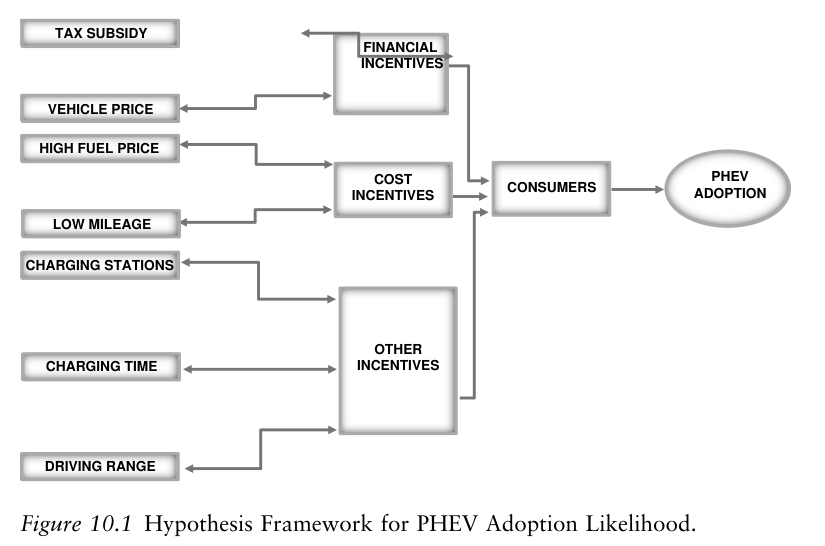
H1. Yearly fuel cost savings has a positive effect on adoption likelihood.
H2. Driving range is the most important factor influencing adoption.
H3. Charging time has a negative effect on vehicle adoption.
H4. Price of PHEVs has a strong negative effect on vehicle adoption.
COST INCENTIVE:
H1 (Null): µ (customers preferring high mileage) ≥ µ (customers preferring high yearly fuel cost savings)
If H1 rejected: propose for H1 (alternative): µ (customers preferring high yearly fuel cost savings) ≥ µ (customers preferring high mileage)
OTHER INCENTIVE:
H2 (Null): µ (customers preferring charging infrastructure) = µ (customers preferring lower charging time) = µ (customers preferring longer driving range)
If H2 rejected: propose for H2 (alternative): µ (customers preferring charging infrastructure) ≠ µ (customers preferring lower charging time) ≠ µ (customers preferring longer driving range)
OTHER INCENTIVE:
H3 (Null): µ (customers preferring higher charging station infra) ≥ µ (customers preferring lower charging time)
If H3 rejected: propose for H3 (alternative): µ (customers preferring lower charging time) ≥ µ (customers preferring higher charging station infra)
FINANCIAL INCENTIVE:
H4 (Null): µ (customers preferring tax subsidies) ≥ µ (customers preferring lower vehicle price)
If H4 rejected: propose for H4 (alternative): µ (customers preferring lower vehicle price) ≥ µ (customers preferring tax subsidies) (Figure 10.1)
Research Design
Descriptive Statistical Analysis and Hypothesis Testing Tools
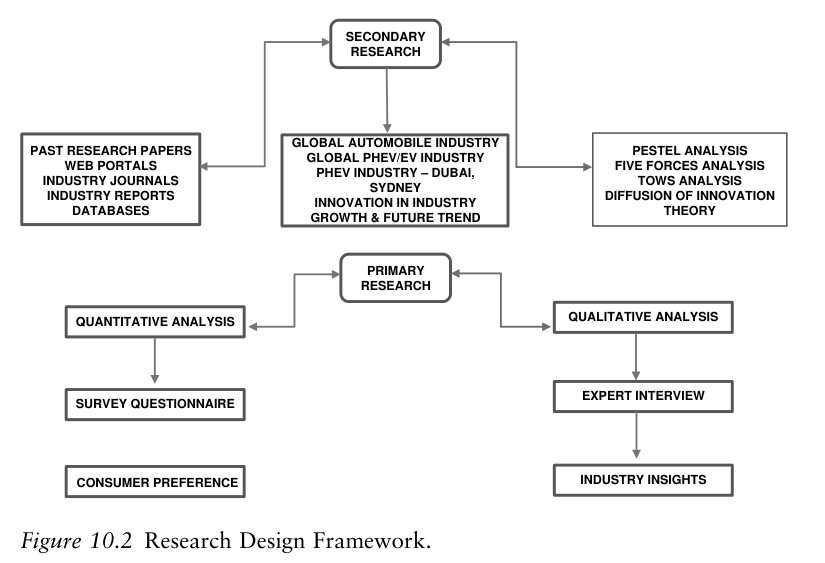
- Descriptive statistics (pie and bar charts) have been used to describe and analyse the demographic data
- For hypothesis testing, t-test and ANOVA single factor test have been used
- For inferential analysis, factor analysis (SPSS) has been employed for variable reduction purpose and to find the relationship among them
- K-means cluster analysis (SPSS) has been used to segment the sample consumers as per group similarities
- Perceptual mapping has been used to display the company’s brand relative to competition (Figure 10.2)
Sampling Methodology and Framework
Methodology
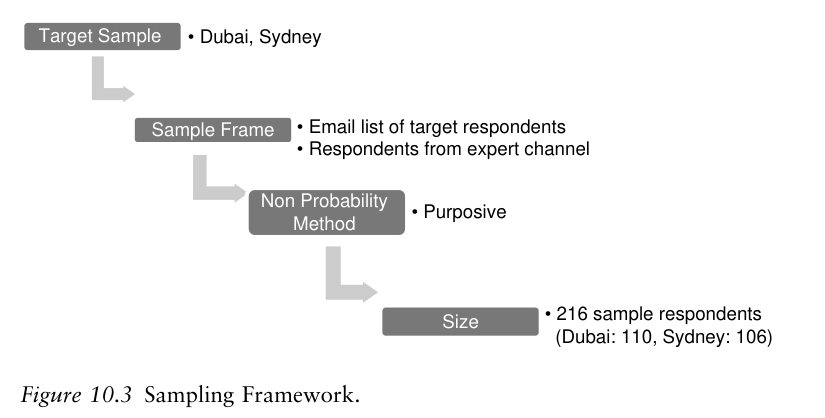
A survey questionnaire for soliciting responses from target respondents was made and administered to 338 individuals. Of these, 216 (the sample size used for the purpose of hypothesis testing) responded to and completed the survey: 110 from Dubai and the remaining 106 from Sydney. Further sector-specific industry insights were solicited through expert interviews administered via an expert discussion guide. Three professionals from Dubai, two from Sydney and one from Japan responded with valuable information related to the global, local and specific PHEV vehicle industry trends.
The consumer survey questionnaire was categorised into these broad sections:
- Demographic information pertaining to gender, age, education, occupation, nationality, family status, location, annual income, vehicle ownership, vehicle usage and purpose
- Specific information pertaining to the hypothesis testing
The next stage of the sampling process consisted of collecting the responses from the sample respondents. The survey was administered to the sample respondents via individual emails and through the channels managed by the industry experts in the respective geographies of Dubai and Sydney.
A non-probability purposive sampling method was used for the purpose of gathering information pertaining to the work.
Findings and Data Analysis
- The findings on demographic- and psychographic-related questions are as follows:
- Out of the 216 survey respondents, 185 were males and 14 were females, representing 86% and 14% of the final respondents.
- 40% of the respondents were in the age group of 30–39 years followed by 26% in the 40–49 years. Thus, 66% of the surveyed population falls in the age group of 30–49 which is the target segment for PHEV adoption.
- 35% of people surveyed were married while 45% were married (with at least one child). Thus, 80% of the surveyed population were married and/or with a single-child family. This shall enable the segmentation process leading to PHEV adoption.
- 52% of respondents had a master’s degree while 15% had Fellowship/PhD degrees which constitutes 67% of the total sample population surveyed. This finding is important as knowledge helps in faster transmission of any new technology (Rogers diffusion of innovation theory) and shall help towards insights for future recommendations.
- 55% of respondents were employed in any form of service followed by 30% who are self-employed or in any form of business. As PHEVs are priced higher than conventional vehicles, this finding shall play an important role for future recommendations.
- Out of the sample respondents, 37% are earning below USD 60,000–80,000 followed by 20% in the USD 40,000–60,000. Interestingly, 94% of the sample respondents are in the income bracket of USD 40,000–>100,000 per annum. Further, this shall enable the demographic segmentation of target population for PHEV adoption.
- The findings on specific PHEV-related questions are as follows:
- 52% of those surveyed agreed to the fact that using a PHEV shall increase their quality of life while 33% disagreed with the statement. A staggering 99% agreed on the fact that PHEV usage shall lead to reduced emissions. However, 41% of the respondents remained neutral towards the fact that a PHEV shall be beneficial to them currently and a further 54% remained neutral when it came to PHEV convenience out of usage. Although 34% agreed on PHEV as a useful means of transport, 46% disagreed regarding the same. This points towards the requirement of increasing awareness levels pertaining to PHEV vehicle usage and the advantages thereon, which is also an important consideration towards the diffusion of innovation theory as proposed by Rogers.
- Regarding PHEV ease of use, only 33% agreed to the fact that using a PHEV would be easy on their part while 45% chose to remain neutral; 35% of respondents believed that it would be difficult to become skilful at using a PHEV while another 35% remained neutral to the fact. A staggering 47% said that it would be difficult for them to schedule battery recharges on account of time and energy constraints. Further, when it came to a PHEV well suited for daily task usage, 35% agreed while 33% disagreed and the balance chose to remain neutral. These findings further prove that there exists a lack of awareness with regard to the PHEV technology and usage amongst the sample respondents.
- When it came to PHEV price acceptance, 54% of the sample respondents found the price of a PHEV unreasonable and only 30% agreed to pay a price premium in order to acquire a PHEV. Further, 44% are unwilling to pay the high price only on account of the higher price of the vehicle battery. These findings prove that there exists a high price notion among the population regarding the high price for a PHEV vehicle and shall aid in the testing of hypothesis for the purpose of the research.
- When asked to respond to the relative importance of specific attributes influencing vehicle purchase, 69% of the respondents said that they give prime importance to vehicle price. When it came to the driving range of the vehicle, 67% of respondents found it to be important as well as the refuelling/charging time. Also, 63% agreed that maintenance costs have an important bearing on vehicle purchase decisions. Further, 98% weighed mileage to be an important factor when it comes to new vehicle purchase, and 85% would prefer their vehicle to be environmentally friendly. Along with the above, the availability of brands and models (66% of respondents) and fuel station infrastructure (82% of respondents) also have an important bearing on new vehicle purchase.
- The earlier points prove that although consumers want environmentally friendly vehicles, high vehicle price, low driving range, high refuelling time, high maintenance cost, fewer available brands and models and less fuel station infrastructure act as deterrents when it comes to new vehicle purchase. These findings shall aid the future recommendations for the purpose of this work.
- When it came to the primary drivers for PHEV adoption, 53% and 22% vouched for its lesser dependency on fuel and the environmental friendliness nature of the vehicle.
- When it came to the primary barriers for PHEV adoption, apart from the price of the vehicle, 30% of the respondents found the lack of charging station infrastructure as one of the primary barriers followed by the time required for charging the battery. This follows from the principle of ‘charging anxiety’, which shall be explained in detail in a later section of the work.
- 62% of respondents are aware of PHEV offerings from Toyota and Nissan, while 23% are aware of Toyota, Nissan and Honda.
Framework
Hypothesis Testing
H1 (Null): µ (customers preferring high mileage) ≥ µ (customers preferring high yearly fuel cost savings)
- Null hypothesis rejected as P < ∞ 0.05
- Proposing alternative hypothesis: customers prefer high fuel cost savings over high mileage as a cost incentive
- Thus, high yearly fuel cost savings has a positive effect on PHEV adoption likelihood
H2 (Null): µ (customers preferring charging infrastructure) = µ (customers preferring lower charging time) = µ (customers preferring longer driving range)
- Null hypothesis rejected as P < ∞ 0.05
- Proposing alternative hypothesis: customers’ preferences regarding charging station infrastructure, charging time, and driving range differ
- Driving range has the most influencing effect
- Thus, driving range is the most influencing factor on PHEV adoption likelihood (high µ value)
H3 (Null): µ (customers preferring higher charging station infra) ≥ µ (customers preferring lower charging time)
- Null hypothesis rejected as P < ∞ 0.05
- Proposing alternative hypothesis: customers prefer lower charging time over high charging station infrastructure
- Thus, high charging time has a negative effect on PHEV adoption likelihood
H4 (Null): µ (customers preferring tax subsidies) ≥ µ (customers preferring lower vehicle price)
- Null hypothesis rejected as P < ∞ 0.05
- Proposing alternative hypothesis: customers prefer lower vehicle price over tax subsidies as a financial incentive
- Thus, high vehicle price has a negative effect on PHEV adoption likelihood (Figure 10.3)
PHEV Attribute Rankings – Dubai versus Sydney
- Similar preferences were shown amongst the sample respondents across the studied geographies of Dubai and Sydney
- Driving range is the most important factor affecting PHEV adoption likelihood
- Tax subsidy was the least important factor affecting PHEV adoption likelihood
- Charging infrastructure had a higher attribute ranking amongst the respondents in Sydney than in Dubai
- Vehicle price ranked higher in Dubai as compared to Sydney as per the sample survey
- Annual cost savings was the second most important factor across both the cities
Factor Analysis
Factor analysis was used to identify the latent variables and for the purpose of grouping similar variables into dimensions and reducing the factors to a smaller number of dimensions. The same helped in simplifying the data and reducing the number of variables. For the data analysis of the collected data, the statistical software statistical program of social science (SPSS) version 22 for Windows was used in performing the necessary calculations so as to obtain accurate data and thus minimise any data processing errors.
- A KMO score of 0.6 suggested suitability of the collected data for factor analysis
- Further, a significance level of 0.000 (Bartlett’s test of sphericity) suggested enough correlation between the variables for conducting the factor analysis
- There are four factors with eigenvalues > 1 and thus were retained for the purpose of the analysis
- 70.73% of variances were accounted for by the four extracted factors
Cluster Analysis
Cluster analysis refers to the technique of classifying objects or cases into comparable homogeneous groups known as ‘clusters’. The most important attribute of this analysis is the lack of prior information about the group membership. The primary usage of this aggregation technique for data analysis is to segment consumers based on the benefits sought from the purchase of the Prius hybrid vehicle and to identify homogeneous groups of PHEV buyers.
The same involved formulating the problem, selecting the measure of the distance and the clustering procedure, determining the number of clusters, interpreting the cluster profiles and finally concluding with the assessment of the validity of the clustering process based on the data collected through the sample survey indicating adoption intention for the Prius hybrid. The distance between the cluster centres indicated the degree of separation of the individual pair of clusters of Prius hybrid buyers. The analysis helped in recommending the segments of customers favourable for PHEV adoption and indicated the distinct clusters which shall be desirable to the marketing department of Toyota for the formulation and implementation of specific segment-oriented marketing strategies so as to target Prius hybrid customers more effectively and increase penetration levels.
K-means cluster procedure (SPSS) was employed to group customers with similar preferential behaviours.
- Primary consumer clusters for PHEVs
- Cluster 1 has the highest number of customer groupings
- Cluster 3 has the least number of customer groupings
- Focus on relative advantage, compatibility, trialability, observability so as to increase awareness levels of PHEVs in order to increase groupings in the ideal cluster (Cluster 2)
Perceptual Map—Toyota Prius
- No vehicle brand occupies a high usability and environmental friendliness position
- Primarily because of the mismatch between the two concepts in consumers’ minds
- Toyota Prius perceived as highly environmentally friendly vehicle but lacks usability (lack of awareness levels)
- Marketing plan of the company to aim at positioning the brand on the top right-hand corner of the map
- Thus, differentiation and brand image shall be magnified if Toyota is able to merge the ‘green’ and the usability factors successfully
Conclusion
Customers primarily expect vehicles (PHEVs) with advanced technology, power, space, safety and high mileage to conform to laid down emission standards. However, their final purchase decision is based on the driving range, ease of recharging (infrastructure) and the price of the vehicle. Driving range (range anxiety) is the most important barrier for PHEV adoption rates in the studied geographies. While vehicle price was a primary limiting factor for Dubai, the lack of availability of sufficient charging stations was holding back PHEV adoption rates in Sydney. The adoption rates in Dubai are steadily increasing owing to governmental vision and support and associated incentives of easy and toll-free drive-throughs.
Sydney sadly presents a bleak picture owing to a lack of vehicle charging infrastructure and a lack of governmental support. The decision to prohibit car manufacturing in Australia will act as a significant barrier for the growth of the industry in that geography.
Lack of PHEV models (variants) is also a limiting factor in both Dubai and Sydney. Although the Prius was initially targeted to innovators and early adopters, with the fourth-generation Toyota hybrid vehicles (Prius, Camry, Avalon), Toyota is focussing on market influencers so as to hasten the adoption process for its PHEV range of vehicles. This proves that although consumers want environmentally friendly vehicles, high vehicle price, low driving range, high refuelling time, high maintenance cost perception, fewer available brands and models and less fuel station infrastructure act as deterrents when it comes to new vehicle purchase in the mentioned geographies.
Recommendation
As per previous data, first three generations of Prius have over 70% HEV global market share. This should be leveraged for potential sales advantage and reputation bases for the fourth-generation Prius. Further, with the development of an efficient distribution channel in the two cities (especially in Sydney), the new Prius with a large-scale integrated communication mechanism (multi-channel) may grow up to command a 40% market share in the coming one to three years. It is also recommended that since the energy efficiency of the current battery is improving by 8% on an average per annum, allowing for increased full electric range. Economies of scale should lower battery prices and, thus, vehicle price. The company could also ensure that the initial models focus towards educating the idea/ concept. The focus of fourth-generation Prius should be remarketed with the idea that the consumer is not required to compromise on power and comfort against economy (mileage + cost savings) and the environment.
Owing to the product being somewhat new to the market, the organisation needs to allocate a substantial amount of its budget. They could do a number of celebrity endorsements to promote the brand and create brand awareness. The company needs to ensure that the advertisements differentiate the fourth-generation Prius and ensure that customers perceive the differences (touch and feel). Added features will help improve vehicle sales and satisfy the target market with an image of an environmentally friendly, efficient, stylish, comfortable and VFM vehicle.
Some of the other improvement options would be
- Dedicated website sub-section for efficient information about Prius fourth generation PHEV
- Dedicated helpline for support and assistance. PHEV specialists should be trained and available to assist
- Dealerships with specific PHEV knowledge for quick customer assistance
Limitations of Current and Future Scope of Research
- The main limitation of this research study pertains to the choice of the number of sample respondents and the sampling technique used. Owing to budgetary and time constraints, the sampling methodology consisted of a non-probabilistic purposive sampling technique. The usage of a significant sample population size for the survey and the employment of a probabilistic sampling technique in the future may result in different results for the variables as tested in the hypothesis.
- Although the importance of charging infrastructure (positive effect on driving range) and reduction of vehicle prices (primarily battery) has been established, the challenge remains for identifying and adding suitable infrastructural network and innovate further so as to have cost advantages which may be passed on to the end consumer (reduction of vehicle price) and accelerate the adoption rate. Further research into the mentioned aspects can provide key insights.
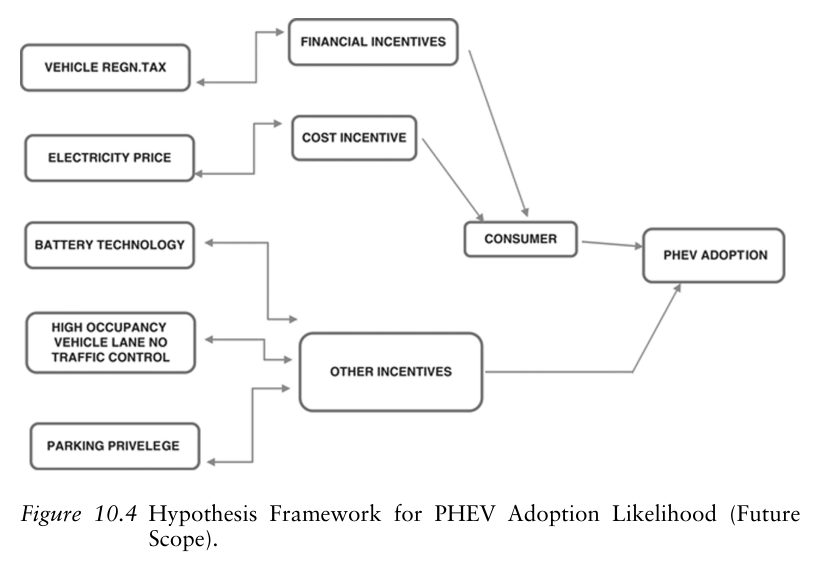
- The below research framework may further be employed for deeper insights into PHEV adoption likelihood in the future (Figure 10.4).
References
Balducci, P. J. (September 2008). Plug-in hybrid electric vehicle market penetration scenarios, Pacific Northwest National Laboratory operated by BATTELLE for the United States Department of Energy under contract DE-AC05-76RL01830, PNNL-17441.
Beliveau, M., Rehberger, J., Rowell, J., & Xarras, A. (April 2010). A study on hybrid cars: Environmental effects and consumer habits. Worcester Polytechnic.
Chua, W. Y., Lee, A., & Sadeque, S. (2012). Why do people buy hybrid cars? The University of Western Australia.
Gao, P., Kaas, H. W., Mohr, D., & Wee, D. (2016). Automotive revolution-perspective towards 2030 How the convergence of disruptive technology-driven trends could transform the auto industry. Advanced Industries, McKinsey & Company.
Garling, A. (March 2000). Market Segmentation, marketing communication strategies and electric vehicle drive. KFB, Stockholm.
Gissler, A., Raab, C., Tix, M., & Merk, S. (2016). Electric vehicle market attractiveness – Unravelling challenges and opportunities. Accenture.
Hackbarth, A., & Madlener, R. (December 2011, Revised December 2012). Consumer preferences for alternative fuel vehicles: A discrete choice analysis. Institute for Future Energy Consumer Needs and Behaviour (FCN), School of Business and Economics/E. ON ERC, FCN Working Paper No. 20/2011.
Heutel, G., & Muehlegger, E. (April 2010). Consumer learning and hybrid vehicle adoption: Faculty research working paper series. Harvard Kennedy School, RWP10-013.
International Energy Agency (2010). Electric and plug-in hybrid vehicle roadmap. International Energy Agency.
OECD/IEA. (2017). Global EV outlook 2017 – Two million and counting. International Energy Agency.
Oleksy, D. (May 2016). The drivers behind Electric Vehicle adoption: A quantitative study of EV owners in Norway. Department of Informatics, Universitetet i Oslo.
Raskin, A., & Shah, S. (June 2006). The emergence of hybrid vehicles: Ending oil’s stranglehold on transportation and the economy. AllianceBernstein.
The Report of an Expert Panel. (February 2011). Plug-in electric vehicles: A practical plan for progress. School of Public and Environmental Affairs at Indiana University.
Tsang, F., Pedersen, J. S., Wooding, S., Potoglou, D. (February 2012). Bringing the electric vehicle to the mass market: A review of barriers, facilitators and policy interventions, Sponsored by RAND Europe’s Direct Investment Programme, WR-775.
Tsetsonis, A. (2016). UAE’s auto sector overview, Emirates NBD, Sector Economics.
(2018) https://www.ergon.com.au/network/smarter-energy/electric-vehicles/types-of-electric-vehicles.
(2018). Toyota UAE-Hybrids. www.toyota.ae/world-of-toyota/hybrid/.
(2018). https://explorable.com/pilot-survey.
(2018). https://www.statisticssolutions.com/factor-analysis-2/.
(2018). https://www.statisticssolutions.com/directory-of-statistical-analyses-cluster-analysis/.
(2018). http://freepestelanalysis.com/pestel-analysis-of-automobile-industry/.
(2018). https://www.marketwatch.com/story/teslas-market-value-zooms-past-another-car-maker-2017-06-09.
(2018). https://www.vox.com/2016/6/6/11867894/electric-cars-global-sales.
(2018). https://en.wikipedia.org/wiki/Automotive_industry_in_Australia.
(2018). https://www.finder.com.au/car-manufacturers-australia.
(2018). https://mtawa.com.au/membership/member-communication/latest-news/item/3142-australian-auto-industry-worth-37-billion.html.
(2018). https://www.smh.com.au/opinion/toyotas-altona-shutdown-end-of-australias-car-industry-an-avoidable-tragedy-20171002-gysj8o.html.
(2018). https://www.slideshare.net/tushars650/pestle-analysis-doing-business-in-australia-39831072.
(2018). https://www.bloomberg.com/news/articles/2017-10-19/death-of-australian-car-making-leaves-chasm-in-blue-collar-towns.