Abstract
Purpose – A retail brand is an asset of value to the stakeholders. Nurturing it enhances quality and stability of earnings. Franchising it across emerging countries provides an opportunity for growth. The challenge, however, is to ensure that the brand stays “connected” with the local markets and “relevant” during changing times. Current research is highly inadequate in guiding the retail brands to stay vibrant when traveling to emerging markets. This research aims to look at how a successful fashion brand in the UK is struggling to grow its retail business through franchise in the Middle East. While the opportunity is vast, the retail brand has been struggling for it has not stayed “relevant”. The paper seeks to present a framework for monitoring its performance so the retail brand can “stay alive”. Design/methodology/approach – Qualitative research was done to understand the profile of the walk-in customers, their shopping behavior, spending motives, and lifestyles. Quantitative research was done to ascertain how the retail brand was perceived in comparison with other brands in the choice set. Further, the study investigated if the shoppers’ profile and preferences varied across different outlets located in different malls. Findings – By carrying out the analyses, distinct segments were deciphered. It has been noticed that the customer profiles for the retail brand studied varied across different retail locations. Variations in their shopping preferences implied that different merchandising and in-store promotion activities are required at different outlets to connect with different segments. Originality/value – The research addresses the gaps in existing literature. The study emphatically confirms that a retail brand franchised cannot take its existence for granted. The study also presents a framework – a dashboard of retail metrics, for measuring, monitoring, evaluating and rejuvenating the performance of retail brands. Keywords Branding, Brands, Franchising, Retail, Retailing, Middle East Paper type Research paper
Introduction
Over the years, many retail brands have met an untimely death. Some retail brands fail because when they travel across borders, by way of “franchising,” they do not connect well with the local needs. Even if successful, a retail brand’s staying power is being continuously tested by turbulence in the business environment. Luxury brands such as Prada, Zara and Polo Ralph Lauren are faced with the challenge of maintaining an exclusive “premium” position while being “affordable” in an economic downturn and also harnessing opportunities in emerging markets (O’Donnell, 2009). Retail brands that stay alive are those that constantly and tactfully connect with shoppers’ needs and expectations. Zara, a popular fashion brand of Spanish origin has immense success in Dubai and the Middle East (RLI Feature Borders, 2010) through the franchising with the Azadea group. The Azadea group has other popular brands like Mango and Massimo Dutti in its portfolio. The local partners now look forward to the expansion of the brand to Egypt and emulate the Dubai success model (Zawya, 2010). Vol. 7 No. 1, 2012 pp. 66-82 r Emerald Group Publishing Limited 1450-2194
The authors would like to acknowledge the efforts of the students at S.P. Jain Center of Management – Ms Rika Bothra, Ms Shivani Kakkar and Mr Simarjit Singh Suri who helped them conduct this research for FashionPro in Dubai.
There is a dearth of academic literature or case studies providing guidance on how declining retail brands can be turned around.
The context This paper illustrates how a retail franchise can overcome the challenges to grow profitably in a turbulent business environment. The study pertains to a fashion apparel brand from the UK franchised in the United Arab Emirates (UAE). The Dubai market has been chosen for study. The case examines the importance of retail franchising and provides an approach to assessing shifts in a business environment, a framework for evaluating retail performance; process of understanding how well the franchised brand “connects” with its local customers; and, a set of metrics for a dashboard for ensuring the retail brand stays on course. Franchising in Dubai Franchising occurs when one firm, the franchisor, sells to another, the franchisee, the right to distribute its branded goods or services for a specified period of time in a specific location. Franchisors usually provide a range of services such as training, site selection, marketing support, quality programs and vendor certification. In return, franchisees pay an upfront fee and a continuing sales royalty, while agreeing to follow the franchisor’s standard operating procedures as specified in the written contract and operations manual (Gillis and Combs, 2009). For a franchisee, the benefit is that they get an established brand and can enter the market faster with confidence, while for the franchisor it ensures reduction of capital, costs and rapid growth of the brand into different markets. In a global economy, the most widely chosen way for a home-brand to establish its footprint internationally is through the mode of franchising. Dubai is a hub to various international brands. Most of them have entered the Dubai market in partnership with local trading partners by franchising. Some of the successful high-end fashion brands in Dubai are Zara, Mango, H & M, Forever 21 and Topshop. While the first three are of European origin, the latter two are of British origin and all are franchised through local partners. FashionPro: challenges in navigating for profitability and growth FashionPro[1] is a British brand franchising through a local partner in Dubai, Brandwagon LLC.[2] Brandwagon is a large retail conglomerate in Dubai with FashionPro being a cardinal brand in its portfolio. Brandwagon has been facing difficulty in ensuring the brand’s profitability and growth across its stores in the UAE. FashionPro humbly began with its first launch in 1970 in London. Currently there are more than 1,000 stores across UK, Republic of Ireland, Europe, the Middle East, Russia, Singapore and Poland. FashionPro is essentially an affordable fashion brand, which believes in providing trendy styles to its customers straight from the catwalks, celebrities and streets. They are not only into ladies fashion, but are fast gaining popularity in the menswear line as well. They have widespread online presence and actively promote business through online channels. Brandwagon launched the first FashionPro store in the region in 2006. Including the newest one opened at Mirdif City Center, it has a total of 17 stores spread across the Middle East region in UAE, Saudi Arabia, Kuwait, Bahrain and Egypt.
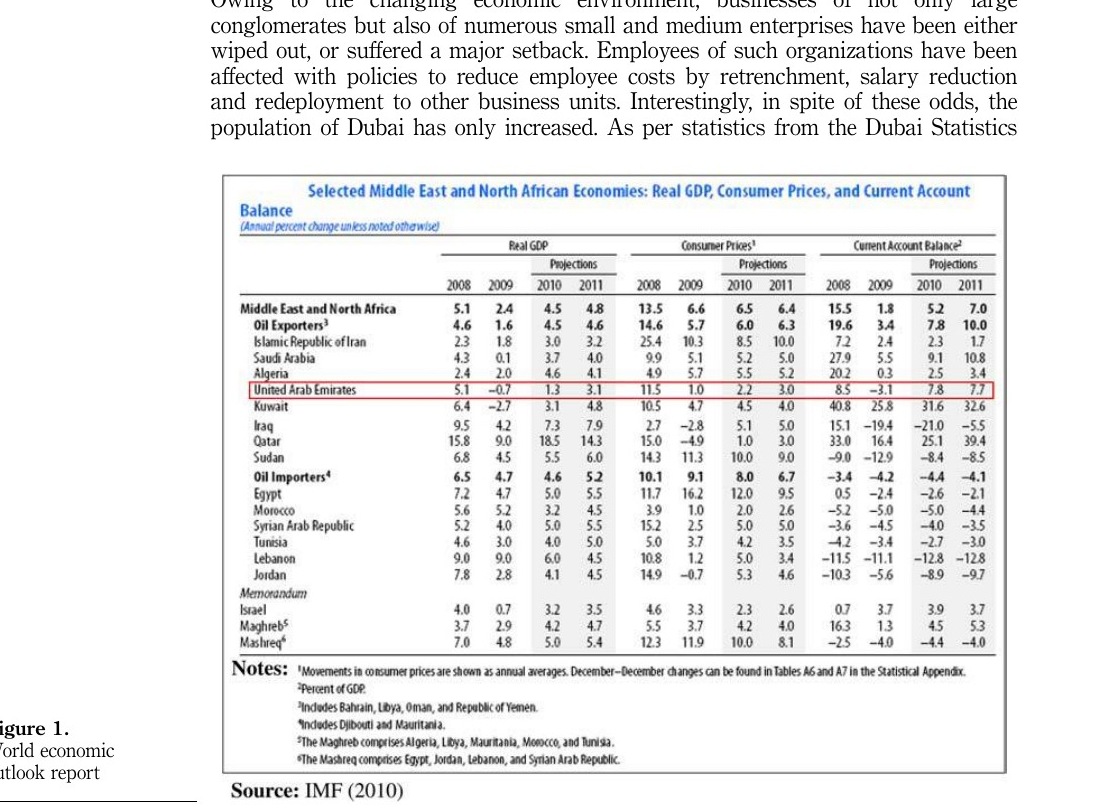
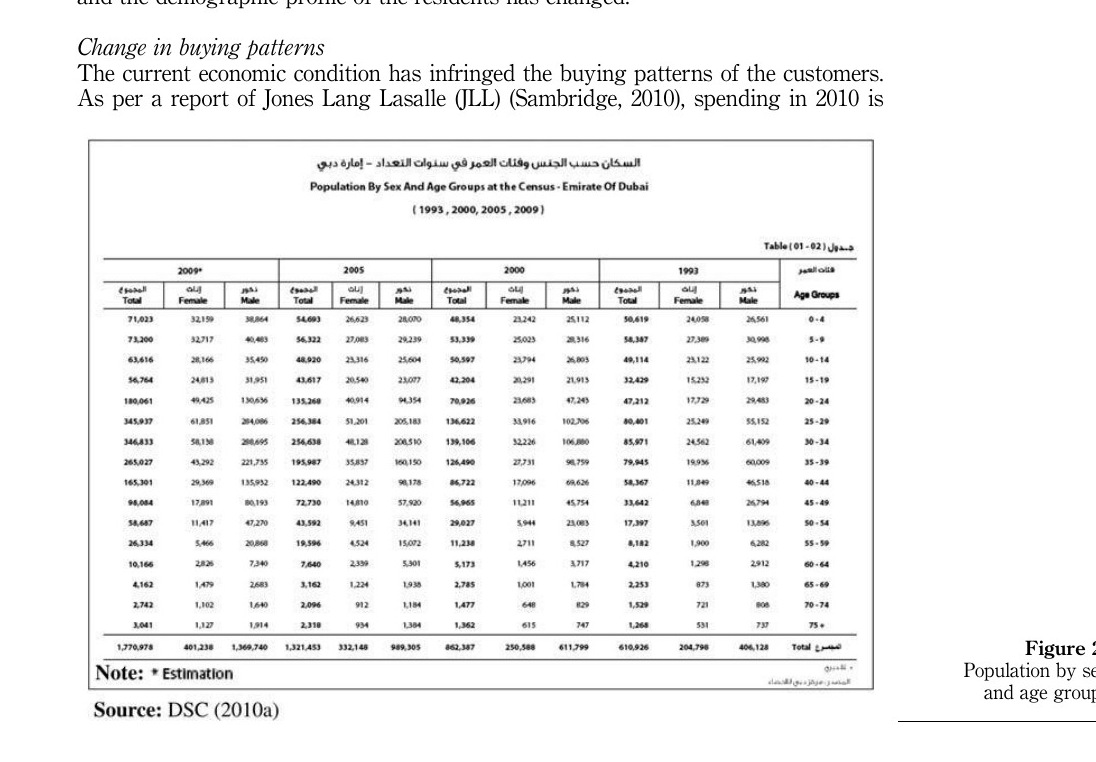
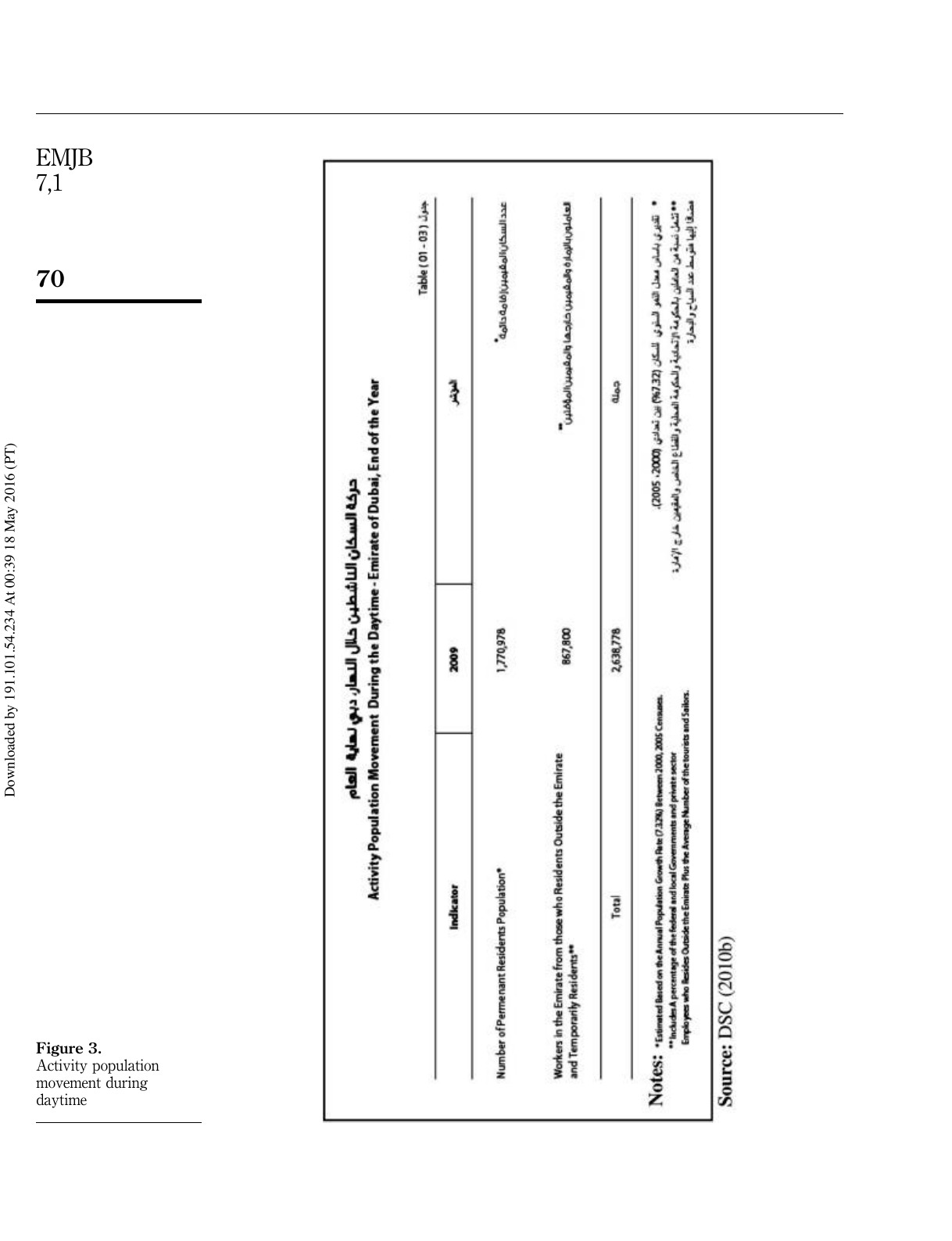
Turbulence in business environment FashionPro stores in Dubai suffered in terms of revenue and profits during the recent turbulent business environment. Changes in economic environment According to a report by the International Monetary Fund (2010) (“World economic outlook”) the Middle East North Africa region has experienced a major setback. In the UAE, growth in 2010 is projected to be subdued at 114 percent, with property-related sectors expected to contract further (Figure 1). There is substantial uncertainty about this outlook. The first risk is that of a slower than expected recovery in advanced economies. This would adversely affect the region’s export earnings, fiscal and external balances and growth. The second risk relates to the aftermath of the Dubai World debt crisis, the full economic impact of which may not be felt for some time. In particular, a possible re-pricing of quasi-sovereign debt could have a lasting effect on financial systems, corporate sectors and, more generally, economic activity in the area. Shift in demographics Owing to the changing economic environment, businesses of not only large conglomerates but also of numerous small and medium enterprises have been either wiped out, or suffered a major setback. Employees of such organizations have been affected with policies to reduce employee costs by retrenchment, salary reduction and redeployment to other business units. Interestingly, in spite of these odds, the population of Dubai has only increased. As per statistics from the Dubai Statistics Center (DSC), Dubai continues to add more than 10,000 residents per month, with population crossing the 1.8 million mark in the first quarter of 2010. Population in the Emirates has grown to more than 1,801,000 residents, up from 1,676,000 at the end of Q1 2009, indicating a growth of 7.5 percent or 125,000 residents in the past 12 months. This latest data are in stark contrast with earlier estimates by international agencies that Dubai’s population would shrink as the Emirates’ real estate and construction sectors suffered a slowdown. Some analysts now maintain that the increasing affordability and availability of residential accommodation and commercial space in the Emirates will result in Dubai’s population increase. Increase in population is a good indicator for retail brands. The challenge, however, remains in understanding the demographic shifts, changing needs of customers and targeting the right segment with the right value proposition. Dubai has a predominantly young population. As per the figures indicated by DSC (2010a) (“Populations by age”) in Figure 2, the ratio of male to female is 3:1. During the average working day, the active population swells by 50 percent when tourists, sailors and workers of government and private sector, residing outside Dubai commute for work. Active population in Dubai during the day at the end of 2009 averaged 2,638,778, as shown in the Figure 3 (DSC, 2010b). Since the inception of FashionPro in 2006, the population of Dubai has increased and the demographic profile of the residents has changed.
Change in buying patterns The current economic condition has infringed the buying patterns of the customers. As per a report of Jones Lang Lasalle (JLL) (Sambridge, 2010), spending in 2010 is expected to be driven primarily by goods sold in department stores and value chains rather than luxury brands. The customers’ wallet sizes have shrunk and likewise buying capacity and tendencies. People are looking for value and the term “more for less” is more significant today than ever before as one of the toughest recessions has engulfed businesses across the globe (Williamson and Zeng, 2009). Not just luxury but “affordable luxury” brands are needed to reposition the value proposition, because of shifts in the needs and spending patterns of shoppers. As per JLL (Sambridge, 2010), the retail sales fell on average by 30 percent in 2009 as the global economic crisis affected retailing in Dubai. A small recovery is expected in 2010 (3-5 percent). Despite slow growth projected in consumer spending, annual footfall in major malls is expected to rise in 2010, owing to tourist attractions and entertainment anchors within malls. In order to mitigate further decline in profits in the short run, due to lower consumer spending, retailers continue to reduce their inventory, manpower and costs. This is an unfortunate vicious cycle, which kills the retail brand in the long run. Changes in retail landscape Dubai, one of the seven Emirates in the UAE, has been called the “shopping capital of the Middle East.” Dubai alone has more than 70 shopping malls, including the world’s largest shopping mall, Dubai Mall. The city draws a large number of shopping tourists from all over the world. Retail has been one of the fastest growing industries in the UAE for the past few years. Favorable government policies and active participation by the private sector have facilitated one of the world’s most desirable retail environments in terms of investments and revenue generation. Dubai has seen one of the fastest growths in retail space in the world with its gross leasable area per capita increasing from 10.5 sq. ft in 2006 to 14 sq. ft in 2010. It is anticipated that due to abundant growth in retail space there will be an increase in shorter leases, break clauses and rent free periods for retailers, as the market shifts in favor of the tenants. Average estimated rental values have declined by approximately 34 percent over the past year, with an 8 percent drop in the first quarter of 2010. Retail rents continue to fall in Dubai whereas they have stabilized in other cities within the gulf region. The problem The anxiety of Brandwagon LLC for FashionPro was that, although the walk-ins of their stores were very high, the conversion was far too low. As a result, there is not enough business being generated, increasing non-moving stocks and mounting operating losses. If this trend was to prevail, continuance of FashionPro in Dubai and the performance portfolio of Brandwagon would be questionable. The need of the hour is to understand the initiatives for navigating the brand to keep it “alive.” The silver lining is that the walk-ins (or traffic) into the stores has not declined.
Research methodology
A research was conducted across three FashionPro stores at three distinct malls – Mirdif City Center, Burjuman and Dubai Mall. A two-pronged approach was followed: first, qualitative research through in-depth interviews was carried out. Next, based on the insights gathered, a questionnaire was designed to survey FashionPro walk-ins in the three malls.
Qualitative research Preliminary in-depth interviews were conducted with a few store managers of FashionPro outlets. This was to understand the walk-ins, conversion of walk-ins into buyers, their spending patterns, amount and nature of spend, margins earned, etc. In-depth interviews were also carried out at outlets with some walk-in customers of FashionPro to understand who they were, why they were buying or not buying, their spending patterns and tendencies for the future, their lifestyles and interests. This was done by using a discussion guide, comprising of several open-ended questions for eliciting responses. Quantitative research The quantitative research was to ascertain the precise profile of the walk-in customers and if they varied across the three different outlets studied in three different malls. Specific questions were asked with respect to reasons for shopping, average spend per visit and frequency of shopping. Online behavior and willingness to receive promotional messages via e-mail was also studied. The profiles of the respondents were ascertained with respect to age, nationality, occupation and lifestyles. Awareness of FashionPro was also assessed. All the respondents were asked to evaluate the importance of retail store attributes and how the outlets in different malls were perceived on those attributes. Responses for a statistically valid sample of 102 were tabulated. A statistical research package SPSS, version 15 has been used for analyzing the gathered data. Observations Qualitative observations By talking to the retail experts and store managers of FashionPro, it was very evident that Dubai’s economy is going through turbulence and the outlets are experiencing a decline in revenues and profitability. Surprisingly, this is happening in spite of high walk-ins. The challenge for FashionPro is to convert the walk-ins into business that is profitable. Insights from qualitative research helped to indicate the motives for shopping at FashionPro. It also appears that the profile of the walk-in customers and their lifestyles varied across the outlets. Quantitative observations The qualitative research served as a basis for designing a structured questionnaire for the survey. In the sections that follow, the data gathered has been analyzed and presented. The analysis showed that the purchases depend on consumers’ having disposable income, feeling confident about their future, trusting in business and economy, embracing lifestyles and values that encourage consumption (Quelch and Jocz, 2009). The intent of the analysis was to understand the shopper’s buying behavior, given the major turbulence in Dubai’s business environment. If understanding customers’ needs is vital in a booming economy, understanding shifting needs of customers in recessionary times is imperative. A need-based segmentation using cluster analysis was done. Three distinct segments were deciphered, each having a distinct need for visiting a store. The pictorial description of the segments is as given in Figure 4.
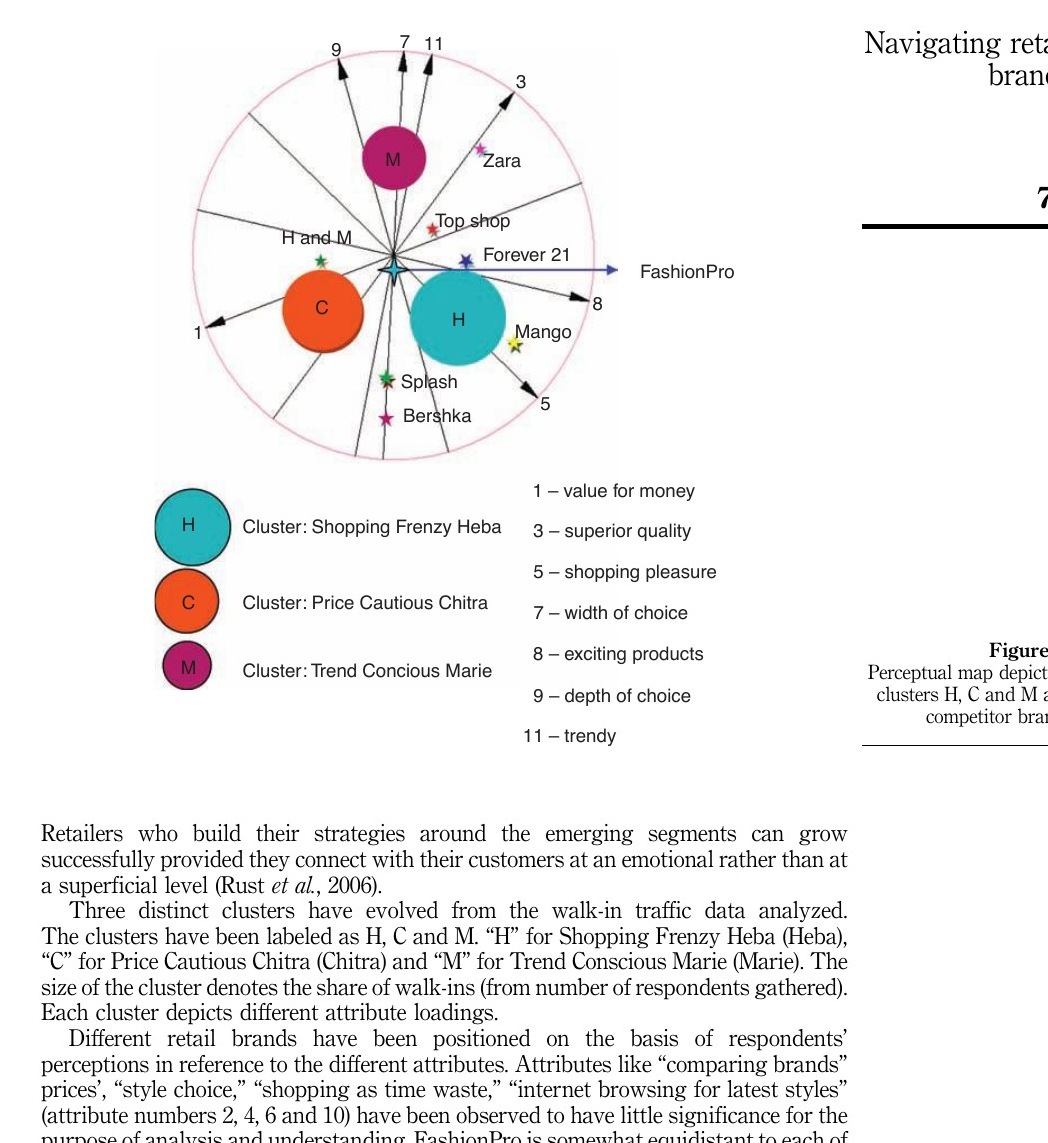
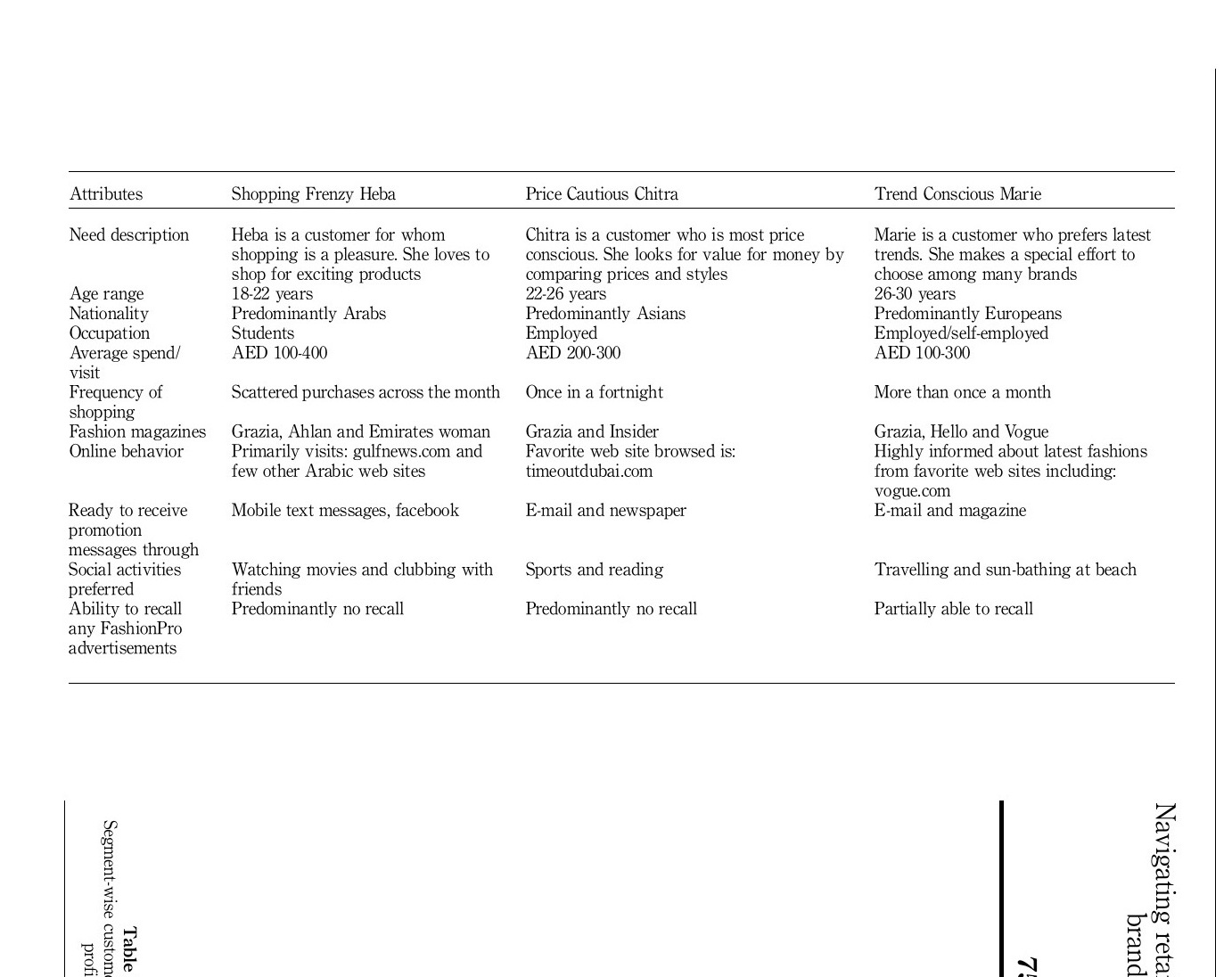
Retailers who build their strategies around the emerging segments can grow successfully provided they connect with their customers at an emotional rather than at a superficial level (Rust et al., 2006). Three distinct clusters have evolved from the walk-in traffic data analyzed. The clusters have been labeled as H, C and M. “H” for Shopping Frenzy Heba (Heba), “C” for Price Cautious Chitra (Chitra) and “M” for Trend Conscious Marie (Marie). The size of the cluster denotes the share of walk-ins (from number of respondents gathered). Each cluster depicts different attribute loadings. Different retail brands have been positioned on the basis of respondents’ perceptions in reference to the different attributes. Attributes like “comparing brands” prices’, “style choice,” “shopping as time waste,” “internet browsing for latest styles” (attribute numbers 2, 4, 6 and 10) have been observed to have little significance for the purpose of analysis and understanding. FashionPro is somewhat equidistant to each of the clusters H, C and M. Splash and Bershka appear to be scoring high on “width of choice”; surprisingly, Zara appears to be an obvious winner in terms of “superior quality”; while “shopping pleasure” is the key driver for Mango. H and M for its “value for money,” Top Shop a distant second to Zara and Forever 21 for its “exciting products” are the closest competitors to FashionPro.
Figure 4. Perceptual map depicting clusters H, C and M and competitor brands
Profile of customers
The segment-wise analysis has been done to understand the distinct benefits sought by each segment, their demographics, lifestyle, shopping behavior and information search practices (Table I). The three segments identified were:
(1) Shopping Frenzy Heba: a shopping enthusiast with high disposable cash and erratic buying patterns.
(2) Price Cautious Chitra: one with a limited budget who would compare and contrast value-for-money across brands.
(3) Trend Conscious Marie: individual with an eye for fashion with high frequency to shop for examining the width and depth of choice.
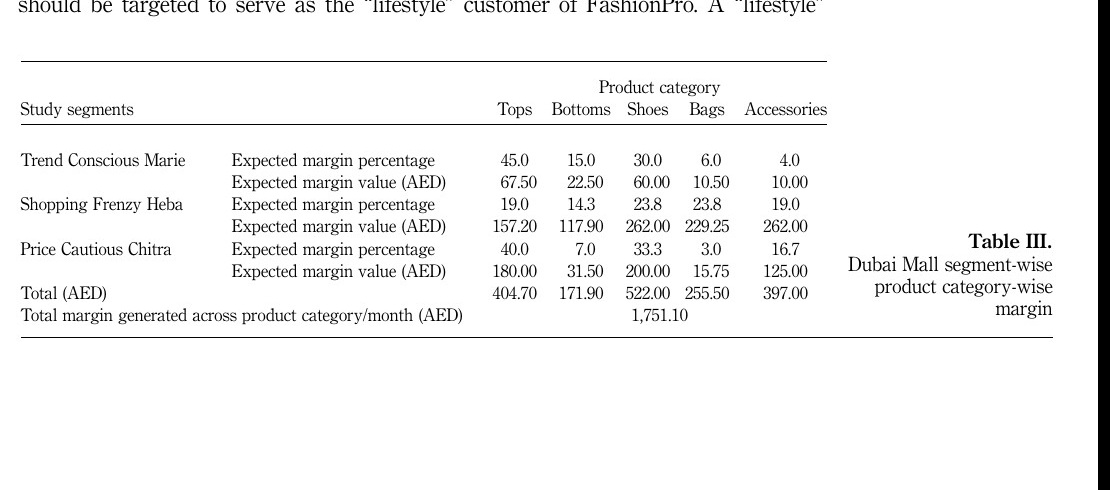
Store-wise analysis Diversity among perceptions of walk-in customers at each store, led us to examine for variation in their perceptions if any, of the three different FashionPro outlets. Toward this, a separate investigation has been done to ascertain the respondents’ perception of the three outlets. The above perceptual map is based on respondents’ ratings on the various operational attributes of FashionPro stores in three malls – Dubai Mall, Burjuman and Mirdif City Center. While the store at Burjuman scored very high on the attributes “merchandise fashionability,” “visual merchandise,” “store hygiene,” “store ambience” and “fitting room” convenience; Dubai Mall scored high on “style options,” “size range” and “time spent at cash counter.” Mirdif store scored high only on “customer service”; which seems to be lagging on other attributes in comparison to the other two stores. To connect well with “Marie,” Dubai Mall store needs to improve on its “merchandise fashionability”; with “Heba,” “store hygiene” and “store ambience.” Dubai Mall store is quite low on customer service levels as has been indicated in Figure 5. Dubai Mall: segment-wise analysis For a retail brand to be successful, it is necessary to stay healthy at all the outlets in all the franchised countries. It is believed that one should have a comprehensive understanding of what is happening at the grass root level of each and every store. In this study an effort is made to understand in-depth the FashionPro outlet at Dubai Mall. As can be observed from Table II, the share of walk-ins is highest among the Heba segment, so is the percentage conversion. Although, “Chitra” has a low percentage share of walk-ins, percentage conversions are fairly comparable to Heba’s. The lowest percentage conversion recorded is for “Marie.” “Heba” generates the largest amount of expected margin across product categories. Table III gives category-wise margin expected to be generated by each segment. Tables II and III provide information for Dubai Mall only. A similar exercise can be performed across all the FashionPro stores to arrive at store-wise performance so as to evolve navigating initiatives for keeping the retail brand alive. Challenges and recommendations There is no generic “one solution-fit-all” to the challenges faced by FashionPro stores. From our perceptual map in Figure 4 we have observed the equidistant position of FashionPro from segments “Heba,” “Marie” and “Chitra.” In today’s scenario, many luxury brands are trying to reposition themselves in response to the changing needs of their customers without devaluing the brand (O’Donnell, 2009). FashionPro needs to ask if it wishes to devise a strategy to primarily target “Marie?” or “Heba?” or both? And, also devise creative tactics to allure “Chitra”? Challenge one that FashionPro faced was to understand the different segments of shoppers that visit its different stores. Since different shoppers exhibited different interests and profiles, the challenge is to understand and decide which segments to reach out to.
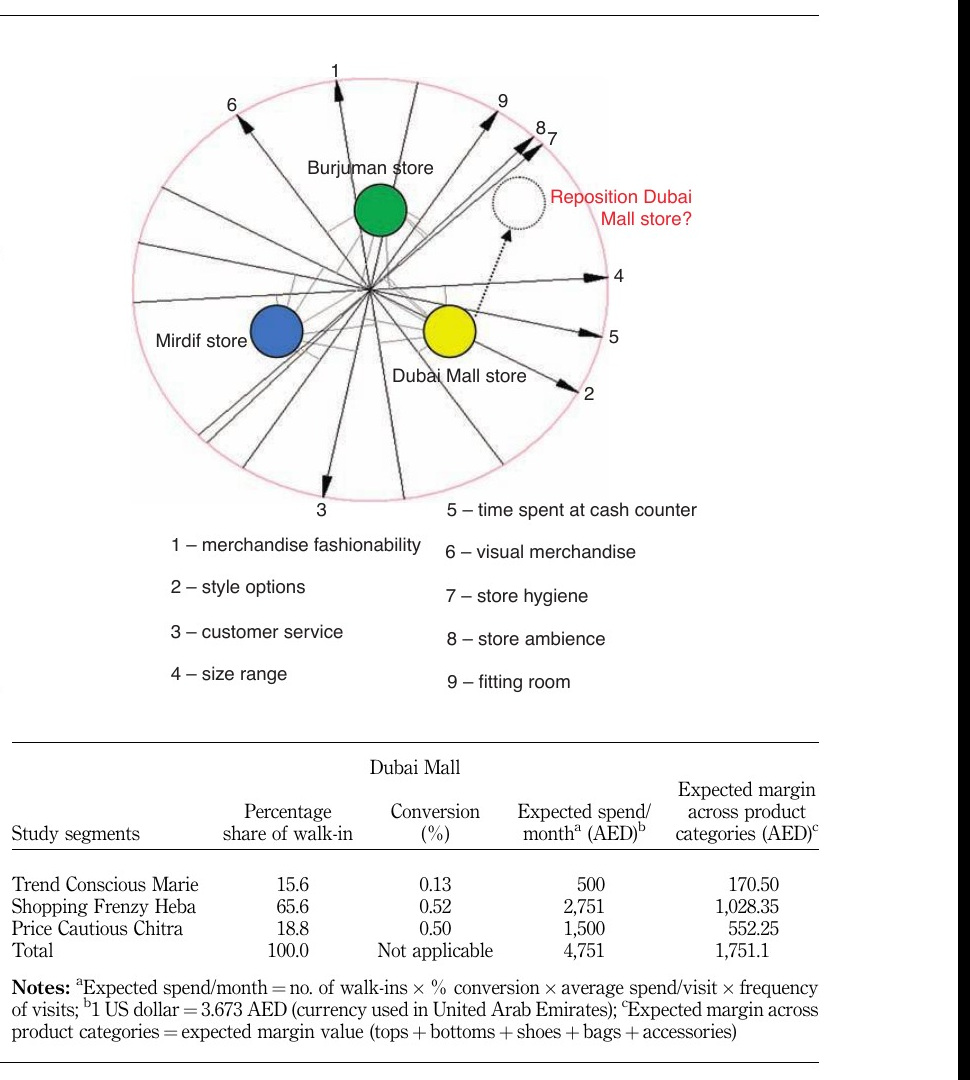
Dubai Mall Study segments
Trend Conscious Marie Shopping Frenzy Heba Price Cautious Chitra Total
Percentage share of walk-in
Conversion (%)
Expected spend/ montha (AED)b
Expected margin across product categories (AED)c
15.6 65.6 18.8 100.0
0.13 0.52 0.50 Not applicable
2,751 1,500 4,751
170.50
1,028.35
552.25
1,751.1
Notes: aExpected spend/month = no. of walk-ins × % conversion × average spend/visit × frequency of visits; b1 US dollar = 3.673 AED (currency used in United Arab Emirates); cExpected margin across product categories = expected margin value (tops + bottoms + shoes + bags + accessories)
First step is to allure the target segments into the FashionPro stores Initiatives have to be adopted to improve the walk-in traffic. Heba predominantly exhibits no recall for the brand FashionPro, however, she is a shopper who finds shopping highly pleasurable. “Heba,” mainly of Arab origin, has the highest disposable cash at her discretion. She is highly active on social networking web sites, which could be targeted to create a buzz for FashionPro among this young segment. Creating fan pages or a social forum for young women to discuss their fashion secrets can be a very cost-effective and high impact marketing initiative. She can be further tempted with promotions through personalized mobile text messages, making her feel special and slowly bonding her to the brand. Her erratic buying pattern is indicative that she is not a loyalist and loves to choose from many brands. Research indicates that customers who are neither loyal to you nor to your competitors should be targeted (Favaro et al., 2009). By offering the right value proposition to them, one can eventually make them loyal to a brand; in our case to FashionPro. Chitra is a young professional with a limited budget and time to spend, which explains her value for money behavior. Mostly Asian, she is a young expatriate working in Dubai. Highly price cautious, she would compare between few brands before making a choice. Her brand recall for FashionPro is rather low and best way of alluring her is to keep her abreast about the latest promotional offers. She is the type who would look for such information in the local newspapers and hence, it would be a good idea to advertise during major shopping festivals. “Marie” is a more mature customer, looking for trendy products. Largely of European origin, Marie exhibits partial recall for FashionPro. Reasons could be twofold one, UK being the country of origin; two, her high information-seeking tendency about latest fashion and styles. Her propensity to buy often (more than once a month) is notable. She would love to receive updates on new merchandise additions through FashionPro newsletter via e-mail. Challenge two that FashionPro faced was to probe on the choices with respect to merchandise, in-store layout and service standards that each of the target segments exhibited.
Step 2 is to increase the conversion ratio for the walk-ins received at each store As noted in Table II, conversion ratio is relatively highest for Heba, yet only half the walk-ins (approximately) are buying from FashionPro. From Table III, it can be observed that their buying is spread across all product categories. This segment should be targeted to serve as the “lifestyle” customer of FashionPro. A “lifestyle”
Study segments Trend Conscious Marie Shopping Frenzy Heba Price Cautious Chitra
Expected margin percentage Expected margin value (AED) Expected margin percentage Expected margin value (AED) Expected margin percentage Expected margin value (AED)
Total (AED) Total margin generated across product category/month (AED)
Tops
Product category Bottoms Shoes Bags
45.0
67.50
19.0
157.20
40.0
180.00
404.70
15.0
22.50
14.3
117.90
7.0
31.50
171.90
30.0
6.0
60.00 10.50
23.8
23.8
262.00 229.25
33.3
3.0
200.00 15.75
522.00 255.50
1,751.10
Accessories
4.0
10.00
19.0
262.00
16.7
125.00
397.00
customer is one who would not only buy basic merchandise but a complete wardrobe with shoes, bags and accessories to match her style. Cross-selling and up-selling for Heba can be done by one, conducting training to educate store personnel on service delivery; two, “incentivize” personnel for increasing transaction value per customer; three, by dressing up the mannequins in the same manner as you would like your customer to buy, with not just tops and bottoms, but furbishing it with other accessories like handbags, shoes, scarves and even ear-rings and rings for creating an image of what a prospective shopper is looking for. Conversion for the Chitra segment is approximately 50 percent, yet she predominantly buys from only one category of merchandise – tops. Possibly, she faces fit issues on bottoms and shoes since sizes of FashionPro are as per European standards and not appropriate to the physique of Asian women. A value section in the store can be created subtly to provide a lucrative offer to “Chitra” without jeopardizing the image of FashionPro. Conversion for the Marie segment is the lowest and her buying is skewed toward tops and shoes. She appears to be a loyal customer of FashionPro. Hence, if she is not buying enthusiastically across product categories, then she is probably not finding the right merchandise. A “latest entrants” section within the store can be created, where the most recent “window”[3] of merchandise is displayed. To create effective visual impressions, pictures of FashionPro models wearing the same merchandise as on display, should be made available around the section area, which would act as a buzz creator. For example, Marie’s interest in “sunbathing” is an excellent cue to promote beachwear line currently offered by FashionPro, however not projected or promoted well. Both the transaction value and margins helps steer the brand toward growth and profitability. Ensuring this at the segment level for each store will enhance the retail brand’s health at the store level and thus at the region/country level. Challenge three was to continually stay connected with the target segments of the brand and be able to drive them toward the brand on a continual basis. Also, the challenge was to ascertain a distinct strategy for each of the locations since profile of customers visiting different outlets is different. The third step is to generate repeat purchase from the target segments A customer relationship management (CRM) process has to be put in place to generate repeat purchases from each of the segments. A record of “attitudes,” “interests” and “opinions” of each customer should be formulated and updated (at store and back-office). The observations made here thus far are in the context of Dubai Mall FashionPro store only. A similar exercise can be carried out across other stores to arrive at an appropriate strategy for each one, since each store is visited by more than one segment in varying numbers (Favaro et al., 2009). This customization of in-store promotions, merchandise-mix on display, visual merchandising and responsiveness of store personnel can result in a marked improvement in FashionPro’s performance. Challenge four is to evaluate each store continually to monitor its performance and navigate it toward growth and profitability, so the retail brand FashionPro becomes stronger and stays healthy. Step four is to develop a “dashboard” of retail performance metrics Research has indicated the importance of measuring marketing performance. Unfortunately, it is not the same as measuring the output in a controlled factory
environment. Measuring the effect of marketing initiatives on customer behavior and the store performance is far too complex (McGovern et al., 2004). Generic measures of marketing performance such as overall customer satisfaction has little value, as it does not indicate the customer’s perception of say, waiting period at the cash counter or service offered by store personnel. To monitor the performance of a retail brand on a continual basis, metrics need to be delineated along the following lines: Walk-ins – in a mall location, assuming that all malls are attracting high footfalls; a drop in walk-ins for a store is indicative that the brand has not positioned itself well and has not been promoted to its target segment, thus having low awareness among prospective customers. Conversions – a low conversion ratio of the existing walk-ins indicates that the value proposition toward its target segment is low. Transaction value – a low transaction value is indicative that the store is not merchandised with the right product-mix. It could also be reflective of low incentive provision for the sales staff due to which the merchandise is probably not being promoted for sale. Average profitability per transaction – cross-selling and up-selling need to be ensured to increase the basket size in a manner that the margins reaped on the sale are higher. If the transaction size is high, yet profitability is low, perhaps cross-selling of high margin items (e.g. accessories) is not being done. Repeat purchase – enormous profitability increase can be gained by emotionally connecting with the customers, thus the need for a CRM program so as to reconnect with the customers on a regular basis. Share of Wallet – it can be defined as a percentage share of the total spend for apparel in the affordable fashion category at our store. Net Promoter Score (NPS) – an NPS score is percentage promoters minus percentage detractors and correlates well with company’s growth (Reichheld, 2006). Customers are posed with a question: “How likely are you to recommend us to a friend or colleague?” and then results are scored on a scale of 0-10, with 0 representing “not at all likely” and 10 representing “most likely.” One group which gives a score of 9 or 10 are known as “promoters.” They report by far the highest repurchase rates, account for more than 80 percent of referrals and are a source of the company’s positive word-of-mouth. The second group comprises of those who give a score of 7 or 8. Their repurchase and referral rates are lower by 50 percent to promoters, termed as “passives.” Finally, those who give a rating between 0 and 6 are known as “detractors,” who are least likely to repurchase or refer and account for more than 80 percent of negative word-of-mouth. Analysis of the different segments being targeted by each store should be evaluated as per the metrics identified. The retailer can use the dashboard as an early warning system, as well as a diagnostic tool for benchmarking and evaluating the performance of each outlet. Allocating costs to different segments and tracking their contribution or operating margins will enable the retailer to assess the return on marketing expenditures from each segment. This will enable one to prune the portfolio of stores so the brand stays profitable and healthy.
Way forward
The framework in Figure 6 summarizes the different approaches a retailer can take and resulting consequences. The retailer can be classified into four different situations depending upon their responses to changes in business environment as follows:
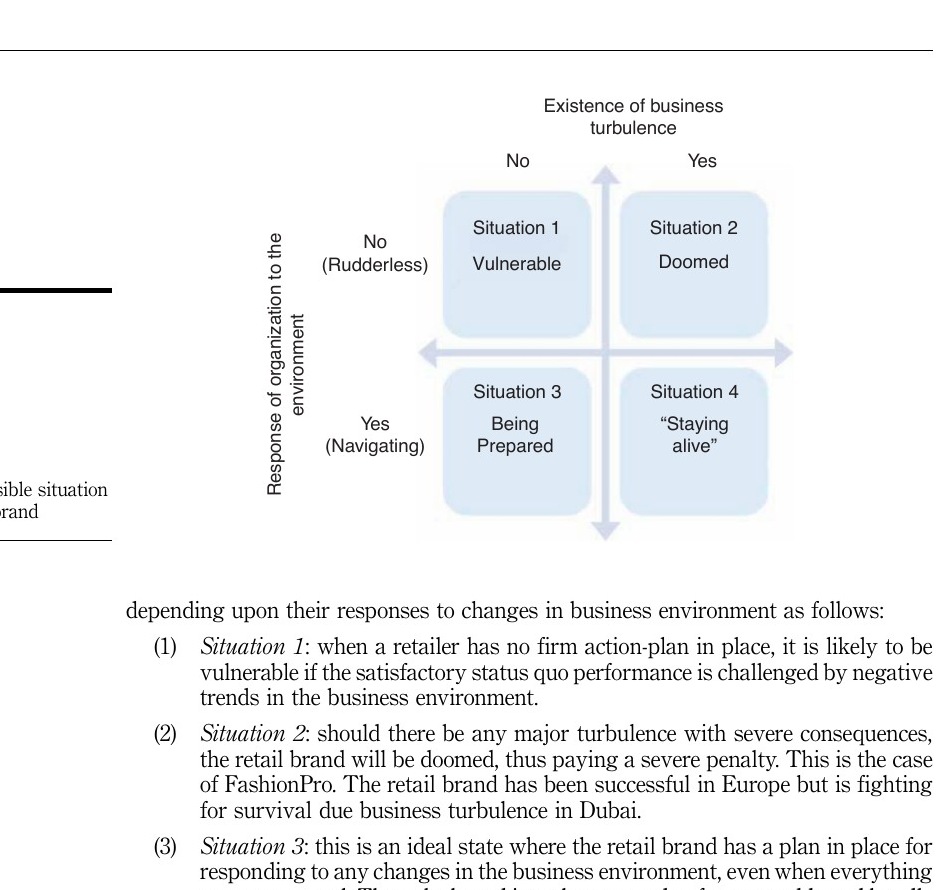
(1) Situation 1: when a retailer has no firm action-plan in place, it is likely to be vulnerable if the satisfactory status quo performance is challenged by negative trends in the business environment.
(2) Situation 2: should there be any major turbulence with severe consequences, the retail brand will be doomed, thus paying a severe penalty. This is the case of FashionPro. The retail brand has been successful in Europe but is fighting for survival due business turbulence in Dubai.
(3) Situation 3: this is an ideal state where the retail brand has a plan in place for responding to any changes in the business environment, even when everything appears normal. Thus, the brand is truly prepared to face any odds and handle any adverse developments.
(4) Situation 4: this is a happy situation where a retail brand is staying alive for it is well prepared and navigated itself through turbulence.
Conclusion
There is an increased alliance between foreign brands and local partners for growing business in gulf’s retail sector. European retail brands are finding that their markets are saturated and facing economic slowdown. There is a need for them to franchise across borders to survive and grow; however, the challenge is to ensure that the brand stays healthy and stays on course of growth. Although this paper relates to experiences of a UK-based brand in gulf, it is relevant to every franchisor franchising beyond borders of origin. A good example of success is the Portuguese retail brand “Sacoor Brothers” which entered Dubai three years ago, through Bahrain-based Jawad Business Group. Despite testing market conditions and stiff competition from many top league European brands, they have been highly successful in Dubai. They have maintained a strong position owing to their service differentiation, quality, retail environment and price points. The company has also adapted the brand keeping in mind the nuances of the regional market and preferences of customers it chose to win (Tusing, 2009). The best practice when franchising a retail brand in emerging countries, is to review on an ongoing basis the changing needs of the segments chosen and stay relevant with appropriate value propositions, category management and merchandising plans, communication and in-store promotion initiatives. A dashboard with pertinent metrics will help evaluate and initiate periodic interventions necessary to navigate the retail brand to “stay alive.”
Notes
1. Brand name has been disguised for confidentiality.
2. The company’s name has been disguised for confidentiality. 3. In apparel retail industry merchandise is available at the stores in various batches of fresh style of merchandise, which is displayed at the store; commonly addressed as “window” by retailers.
References
- Dubai Statistics Center (DSC) (2010a), “Populations by sex and age groups at the census – Emirate of Dubai”, available at: www.dsc.gov.ae/Reports/DSC_SYB_2009_1_2.pdf (accessed May 13, 2010).
- Dubai Statistics Center (DSC) (2010b), “Activity population movement during the daytime – Emirate of Dubai”, available at: www.dsc.gov.ae/Reports/DSC_SYB_2009_1_3.pdf
- Favaro, K., Romberger, T. and Meer, D. (2009), “Five rules for retailing in a recession”, Harvard Business Review, No. 4, pp. 1-10.
- Gillis, W.E. and Combs, J.G. (2009), “Franchisor strategy and firm performance: making the most of strategic resource investments”, Business Horizons, Vol. 52 No. 6, pp. 553-61.
- International Monetary Fund (2010), “World economic outlook”, April, available at: www.imf.org/ external/pubs/ft/weo/2010/01/pdf/text.pdf (accessed May 13, 2010).
- McGovern, G.J., Court, D., Quelch, J.A. and Crawford (2004), “Bringing custumers into the boardroom”, Harvard Business School Publishing.
- O’Donnell, K. (2009), “Lux brands face tough balancing act”, Marketing News, February, p. 18.
- Quelch, J.A. and Jocz, K.E. (2009), “How to market in a downturn”, Harvard Business Review, No. 4, pp. 52-62.
- Reichheld, F. (2006), “The microeconomics of customer relationships”, MIT Sloan Management Review, Vol. 47 No. 2, pp. 73-8.
- RLI Feature Borders (2010), “Success lies in the details”, available at: www.rli.uk.com/features/ features/Azadea/azadea.htm (accessed November 28, 2010).
- Rust, R.T., Zeithaml, V.A. and Lemon, K.L. (2006), “Customer-centered brand management”, Harvard Business Review, No. 9, pp. 1-11.
- Sambridge, A. (2010), “Dubai retail sales seen growing 3-5% in 2010”, available at: www. arabianbusiness.com/586550-dubai-retail-sales-seen-growing-3-5-in-2010 (accessed May 13, 2010).
- Tusing, D. (2009), “Finding a place in a crowded world”, available at: http://arabianfranchise.com/?p=1068 (accessed November 23, 2010).
- Williamson, P.J. and Zeng, M. (2009), “Value- for- money strategies for recessionary times”, Harvard Business Review, No. 3, pp. 1-10.
- Zawya (2010), “Azadea group expands in Egypt with mall of Arabia”, available at: www.zawya.com/story.cfm/sidZAWYA20101019101302/Azadea%20Group%20Expands%20in%20Egypt%20With%20Mall%20of%20Arabia%20 (accessed November 28, 2010).
Further reading
Tikoo, S. (1996), “Assessing the franchise option”, Business Horizons, No. 3, pp. 78-82. UAE Interact (2010), “10,000 new residents arrive in Dubai per month”, available at: www. uaeinteract.com/docs/10,000_new_residents_arrive_in_Dubai_per_month/40354.htm (accessed May 17, 2010).
About the authors
Balakrishna Grandhi is the Dean of Executive MBA (Dubai, Singapore and Sydney), Professor and Head of Marketing. His professional interests include: strategic retailing, marketing management, strategic marketing, business to business marketing, product portfolio strategies, new product development, marketing of services, sales and channel management, and strategic brand management. Owing to his academic excellence, rich experience in the corporate world and teaching across the globe, he embraces a cross-cultural, cross-functional, pragmatic and global perspective in solving corporate anxieties in the changing business environment. Professor Grandhi is a member of the American Marketing Association and the Chartered Institute of Marketing (UK). Balakrishna Grandhi is the corresponding author and can be contacted at: [email protected] Jyothsna Singh is an Academic Manager, Marketing. She has rich retail industry experience in Dubai and India in the field of brand management and retail operations. Her professional interests include strategic retailing, strategic brand management, marketing management, and emotions at work (particularly service industry). Nitin Patwa is a Senior Academic Manager, Quantitative Techniques. He has a variegated teaching experience across various educational institutes in India and Dubai. His professional interests include research methodology, quantitative techniques, accounting, and financial management.
This article has been cited by:
1. Hyun Hee Park, Jung Ok Jeon, Pauline Sullivan. 2015. How does visual merchandising in fashion retail stores affect consumers’ brand attitude and purchase intention?. The International Review of Retail, Distribution and Consumer Research 25:1, 87-104. [CrossRef]